Volume 4: South-East England
Select a site alphabetically from the choices shown in the box below. Alternatively, browse sculptural examples using the Forward/Back buttons.
Chapters for this volume, along with copies of original in-text images, are available here.
Current Display: Sompting 11, Sussex 

Overview
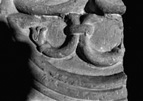
Object type: Frieze or blind arcade fragment [1]
Measurements: H. 40 cm (15.8 in); W. 47 cm (18.5 in); D. 8 cm (3.2 in)
Stone type: Pale yellowish-grey, fine-grained, pelletal limestone; Caen stone, Calcaire de Caen Formation, Bathonian, Middle Jurassic; Caen, Normandy2
Plate numbers in printed volume: Ills. 175-180
Corpus volume reference: Vol 4 p. 177
(There may be more views or larger images available for this item. Click on the thumbnail image to view.)
Present Location
Reused (with no. 10) for Romanesque panel of Christ in Majesty at north-west end of nave
Evidence for Discovery
See Sompting no. 10.
Church Dedication
St Mary
Present Condition
Pale yellowish-grey, fine-grained, pelletal limestone; Caen stone, Calcaire de Caen Formation, Bathonian, Middle Jurassic; Caen, Normandy[2]
Description
It is rectangular. Only the upper half of the panel is decorated. The decorated area is divided by two arcs of a circle, each composed of a triple roll moulding, which touch close to the upper edge of the panel. The arc to the left is the shorter. Within the frame to the right two stems, whose upper ends have been cut off by the trimming of the edge, are linked together by a collar before curving down and back. That to the right is cut off by the trimming of the edge, but that to the left terminates in an animal head separated from the stem by a collar. The head is small and has an open mouth and an incised reversed lentoid eye. An incised dot indicates the pupil. Within the spandrel formed by the two curving stems is the lightly incised sketch of a backward-looking animal, and in the space defined by each scroll is a pair of incised lines crossing each other at right angles. In the left-hand field there is also an incised curved arc along the upper edge, and in the right-hand field a lightly incised cross, in the upper right-hand quadrant defined by the major incised lines. Within the arc to the left is a stem, cut off by the trimming of the edge to the left and terminating in a downward-facing scroll. A subsidiary downward- pointing stem develops from the main stem to terminate in a similar scroll. Between the two arcs a stem develops from each close to their junction. The stems are linked by a collar where they touch before each curves down and back to terminate in an inward-facing scroll. Each stem has one subsidiary also terminating in an inward-facing scroll. The two subsidiary scrolls touch.
Discussion
This fragment clearly forms part of the same feature as Sompting no. 9. The precise function of the incised sketch and lines remains unclear. It is possible that they represent the beginning of a second stage of decoration which would have filled the (now blank) backgrounds to the scrolls with decoration.
Date
Eleventh century
References
Horsefield 1835, i, 205; André 1898, 18 - 19, fig. 5; Clapham 1935a, 407 - 8; Nairn and Pevsner 1965, 331; Taylor and Taylor 1965 - 78, ii, 562; Kirby 1978, 165; Tweddle 1986b, i, 80, 183 - 5, ii, 467 - 8, iii, figs. 3, 28, pl. 88b
D.T.
Endnotes
