Select a site alphabetically from the choices shown in the box below. Alternatively, browse sculptural examples using the Forward/Back buttons.
Chapters for this volume, along with copies of original in-text images, are available here.


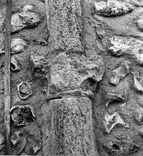
Object type: Capital
Measurements: H. c. 50 cm (19.7 in); W. c. 50 cm (19.7 in)
Stone type: Greenish-grey limestone; Quarr stone, Bembridge Formation, Palaeogene, Tertiary; Isle of Wight
Plate numbers in printed volume: Ills. 196
Corpus volume reference: Vol 4 p. 181-182
(There may be more views or larger images available for this item. Click on the thumbnail image to view.)
It has been suggested (Aldsworth and Harris 1988, 124–5, fig. 15) that this capital, and those in the corresponding positions on the other faces of the tower were originally functional, supporting a shingled gable and helm roof. Only later, they suggest, were the gables rebuilt in masonry and these capitals left floating free. The use of median half-round pilasters on the upper stages of the tower links them architecturally with the tower arch. Like the soffit shafts and roll of the tower arch (Sompting no. 14), these are a feature of Romanesque architecture. Such half-round shafts made their first appearance in Europe towards the middle of the eleventh century as at St Maria im Kapitol, Cologne, building 1049–65 (Gem 1973, ii, 494; Conant 1974, ill. 337), and St Remi, Rheims dedicated in 1049 (Gem 1973, ii, 494).
Although very heavily damaged, the capital appears to have had a volute form, paralleled on Sompting nos. 18 and 20. Such volute capitals, like the upright leaf capitals on the tower arch, represent the debasement of Classical composite or Corinthian forms, with the complete suppression of one of the zones of decoration. On the tower arch it is the volutes which are displaced to form impost-like strips flanking the capitals; they are completely suppressed on Sompting no. 19. On this piece it is the zone of upright leaves which is lost. This type of debasement is paralleled in Lincolnshire where, at Bracebridge and Glentworth, there are similar volute capitals with the zone of upright leaves suppressed (Brown 1925, fig. 192, VII, XVI).
