Volume 4: South-East England
Select a site alphabetically from the choices shown in the box below. Alternatively, browse sculptural examples using the Forward/Back buttons.
Chapters for this volume, along with copies of original in-text images, are available here.
Current Display: Sompting 20, Sussex 

Overview
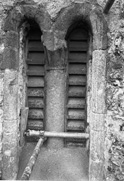
Object type: Capital [1]
Measurements: H. c. 38 cm (15 in); W. c. 23 cm (9 in); D. c. 62 cm (24.4 in)
Stone type: Pale brown, glauconitic, medium-grained, quartzose sandstone; Hythe Beds, Lower Greensand Group, Lower Cretaceous; Petersfield to Pulborough area
Plate numbers in printed volume: Ills. 205-208
Corpus volume reference: Vol 4 p. 183
(There may be more views or larger images available for this item. Click on the thumbnail image to view.)
Present Location
In situ on the mid-wall shaft of the easternmost belfry window on the north face of the tower
Evidence for Discovery
First published in Rickman 1848
Church Dedication
St Mary
Present Condition
Broken and worn; partially restored with new stone
Description
It is of circular plan below, but of narrow rectangular plan above. The east and west faces rise vertically, but the north and south faces expand before being cut off vertically in the same plane as the interior and exterior walls. The capital is separated from the shaft by a narrow roll moulding along its lower edge. From this, on the east and west faces, emerges a pair of outward-leaning, half-round stems terminating in tight scrolls in the upper, outer corners of the face. In the angle between them is a second similar pair of stems.
Discussion
It seems clear that the eastern half of this capital is a later replacement. Aldsworth and Harris have suggested that the tower at Sompting was originally crowned with shingled gables and a helm roof, and that only later were masonry gables substituted, although probably not very much later (Aldsworth and Harris 1988, 124–5, fig. 15). This would place the two capitals Sompting, Sussex (St Mary) nos. 20–1 very late in the eleventh century. This is unsatisfactory as the capitals are decorated in what appears to be a derived version of Winchester-style acanthus, or even the Scandinavian Ringerike style. In either case a date towards the middle of the eleventh century would fit these capitals better. For further discussion see Chap. VII.
Date
Eleventh century
References
Rickman 1848, fig. on xxvii; Crouch 1910, pl. 39; Page 1907, fig. on 363; Brown 1925, fig. 26.VI; Clapham 1930, 135; Clapham 1935a, 405 - 7; Nairn and Pevsner 1965, 330; Taylor and Taylor 1965 - 78, ii, 558, fig. 273; Taylor and Taylor 1966, 51; Fisher 1970, 179 - 80; Gem 1973, ii, 493, 495; Gem 1983, 125, 128; Tweddle 1986b, i, 65, 174, ii, 476 - 7, iii, pl. 93b; Aldsworth and Harris 1988, 117, fig. 11a
D.T.
Endnotes
