Select a site alphabetically from the choices shown in the box below. Alternatively, browse sculptural examples using the Forward/Back buttons.
Chapters for this volume, along with copies of original in-text images, are available here.


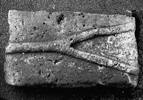
Object type: Part of grave-cover [1]
Measurements: L. 96 cm (37.8 in); W. 57 cm (22.4 in); D. 17 cm (6.7 in)
Stone type: Brownish-grey (with a greenish tinge), medium-grained (0.3-mm quartz grains), glauconitic sandstone; Hythe Beds, Lower Greensand Group, Lower Cretaceous; Petersfield to Pulborough area
Plate numbers in printed volume: Ill. 237
Corpus volume reference: Vol 4 p. 193-194
(There may be more views or larger images available for this item. Click on the thumbnail image to view.)
The lower third of the stone is lost.
A (top): A half-round median moulding bifurcates half-way along the surviving length. The bifurcations terminate on the narrow end, near the corners.
Appendix A item (stones dating from Saxo-Norman overlap period or of uncertain date).
Butler's illustration shows the cover as intact, although this could be an interpretative drawing. Although closely corresponding in size, it is unlikely that Stedham no. 6 is the other end of this stone. The mouldings are of rectangular section, not half-round section as on the present piece.
The evidence for their discovery suggests that these covers were reused as building material in the twelfth century when the nave of the church was rebuilt. Allowing for a reasonably long period of primary use, this points to an eleventh-century date for their manufacture. Evidence from Cocking, Sussex, supports this suggestion. There a similar cover (no. 1; Ill. 228) was recovered from a wall foundation dated to c. 1080.
The eleventh-century date suggested for these grave-covers by the archaeological evidence is reinforced by the decoration on some of them. The use of a median ridge bifurcating at either end, and sometimes with a cross-bar at the point of bifurcation, as on Stedham no. 4, can be paralleled in the late pre-Conquest grave-covers of East Anglia discussed by Fox (1920–1). This type of cover did reach south-east England: see for example, Milton Bryan, Bedfordshire (Ill. 361) and London (St Benet Fink) (Ills. 345–6). The covers from the present site, together with those at Chithurst and Cocking, also in Sussex, may derive in part from these types.
