Select a site alphabetically from the choices shown in the box below. Alternatively, browse sculptural examples using the Forward/Back buttons.
Chapters for this volume, along with copies of original in-text images, are available here.


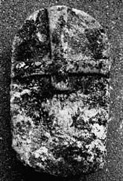
Object type: Grave-marker
Measurements: H. 62 cm (24.4 in); W. 38 cm (15 in); D. 21 cm (8.3 in)
Stone type: Brownish-grey (with a greenish tinge), medium-grained (0.3-mm quartz grains), glauconitic sandstone; Hythe Beds, Lower Greensand Group, Lower Cretaceous; Petersfield to Pulborough area
Plate numbers in printed volume: Ill. 243-244
Corpus volume reference: Vol 4 p. 196
(There may be more views or larger images available for this item. Click on the thumbnail image to view.)
The stone is rectangular with a semicircular head. It tapers slightly towards the base.
A and C (broad): Decorated with a splayed-armed cross in relief, the lower limb of which is cut off short. The remaining arms terminate on the edges of the face.
Appendix A item (stones dating from Saxo-Norman overlap period or of uncertain date).
Two of the other grave-markers recovered from the west gable and the walling of the nave by Butler, Stedham nos. 10–11 (Ills. 246, 248), were of this form, although neither of them was intact. As with the grave-covers, the archaeological evidence points to an eleventh-century date for these grave-markers. Markers with semicircular heads are encountered elsewhere among the pre-Conquest sculpture of south-east England, notably at Rochester 3 (Ills. 147 - 50) where the piece is decorated in the Scandinavian Ringerike style, pointing to a date in the first half of the tenth century, and probably to the period of Scandinavian supremacy between 1016 and 1042. The carving from White Notley in Essex may also have had a semicircular head (Ill. 375), and there are semicircular headed grave-markers among the mid eleventh-century material from Cambridge castle (Fox 1920–1, pl. VII). The grave-marker from Whitchurch in Hampshire also has a semicircular head, but is of much earlier date.
