Volume 4: South-East England
Select a site alphabetically from the choices shown in the box below. Alternatively, browse sculptural examples using the Forward/Back buttons.
Chapters for this volume, along with copies of original in-text images, are available here.
Current Display: Tangmere 01, Sussex


Overview
Object type: Panel reused as window head
Measurements: H. 44 cm (17.3 in); W. 55 cm (21.7 in); D. Built in
Stone type: Greenish-grey or olive-grey, fine- to medium-grained (0.2 to 0.3-mm quartz grains), glauconitic sandstone; some weathered-out sharp ridges may be cherty streaks; probably Hythe Beds, Lower Greensand Group, Lower Cretaceous; Petersfield to Pulborough area
Plate numbers in printed volume: Ill. 219
Corpus volume reference: Vol 4 p. 185-186
(There may be more views or larger images available for this item. Click on the thumbnail image to view.)
Present Location
In situ over the window in the south wall of the nave to the east of the porch
Evidence for Discovery
First recorded in 1907 (Page 1907)
Church Dedication
St Andrew
Present Condition
Heavily worn
Description
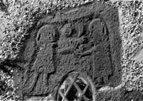
It is sub-rectangular with the arch of the head of the window cut into the lower edge. There is an irregular, broad, low-relief border along the remaining edges. It is decorated with two crude, inward-facing figures, in low relief, one on each side of the window head. That to the left is frontally placed with the head turned to the right, bare legs, and well-marked female genitalia. The body tapers towards the round head. There is no neck. Incised lines indicate the nose, ears, and mouth. The eye is drilled. One arm, with upturned fingers, is extended horizontally towards the second figure. This is in profile. It has bare legs, a parallel-sided body, and an oval head. There is no neck. Incised lines indicate the facial features. The eye is drilled. One arm is extended horizontally holding a heavily weathered object. Above the extended arms, and between the figures, there is to the left a disc, and to the right a crescent, possibly representing the sun and the moon.
Discussion
This panel is arguably reused. The feet of the right-hand figure are cut away, and the upper left-hand corner is lost. As it is now incorporated into a twelfth-century window head, this argues for primary use perhaps in the eleventh century, or conceivably earlier. The simplicity of the carving renders any attempt at art-historical dating impossible.
Date
Stones dating from Saxo-Norman overlap period or of uncertain date in eleventh century
References
Page 1907, 365; Mee 1937, 361, pl. facing 273; Poole 1948, 70, pl. XI; Salzman 1953, 238; Nairn and Pevsner 1965, 347; Fisher 1970, 202; Tweddle 1986b, i, 70, 217, ii, 497 - 8, iii, pl. 107b
D.T.
Endnotes