Select a site alphabetically from the choices shown in the box below. Alternatively, browse sculptural examples using the Forward/Back buttons.
Chapters for this volume, along with copies of original in-text images, are available here.


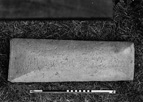
Object type: Grave-cover
Measurements: L. 148.6 cm (58.5 in); W. 53.6 > 48.6 cm (21.1 > 19.1 in); D. 39.6 > 32.8 cm (15.6 > 12.9 in)
Stone type: Pale grey fine-grained limestone, with moulds of gastropods and of Chara nucules; Bembridge limestone, Bembridge Formation, Palaeogene, Tertiary; Isle of Wight
Plate numbers in printed volume: Ills. 509-513, 521
Corpus volume reference: Vol 4 p. 278-280
(There may be more views or larger images available for this item. Click on the thumbnail image to view.)
A coped stone of complex geometry. The long sides rise in convex curves to a flat axial band into which the greater part of the inscription is cut. To either end this flat upper surface expands and curves downwards to form the ends of the coping. The expanded areas are concave across the width of the stone and thus form elegant arrises at each of the four angles. The inscription begins and finishes on the concave end surfaces rather more than half-way down. The entire surface of the coping is dressed smooth, so that the tooling is barely visible. Below the rounded surfaces, the four sides of the stone are vertical and dressed flat, but the tooling remains partly visible. On the two long sides, the curved surfaces pass directly into the vertical edges over a slight arris (Ill. 521). Both ends carry angled rebates between the curved and vertical surfaces (Ill. 510). The left-hand (or western) part of the front (or southern) vertical face is roughly dressed over rather more than half its length, and this dressing continues up into the rounded side above (Ill. 521). The underside of the stone has not yet been inspected.
A hint of a pattern of triangular incisions can sometimes be seen in the right light along the upper bevel on the south side. Whether it reflects the original adzing of the block not entirely smoothed away, or a possible intention, subsequently abandoned, to indicate tegulation, seems quite uncertain. When the grave-cover is properly bedded (as it is in Winchester City Museum) the west end is noticeably higher and wider than the east end.
Inscription The inscription (Okasha 1971, 126–7; eadem 1983, 110; eadem 1992b, 340–1, 345) is incised in a single line along the central axis of the stone. When it was in its original position the inscription ran from west to east and was to be read from the south side, that is, the text began at the head end of the grave. Letters vary a little in height. The initial cross is about 7 cm (2.75 in) and the final A is 7.9 cm (3.1 in). Letters along the ridge are somewhat constricted by the narrow field but are also more worn and so difficult to measure: the S at the end of the ridge is about 5.8 cm (2.3 in) high. The letters increase in height again as the field flares out again at the end of the stone. The inscription is in capitals and may be transcribed as follows:
+HERLI[Ð]G[VNNI:EO]R[LE]SF/E[O]L/AGA
The language is Old English and the reading is straightforward:
+ HER LIÐ GV[N]N[I] [:] EOR[L]ES FEOLAGA
(Translation: '+ Here lies Gu[n]n[i], the earl's companion', or perhaps 'Here lies Gu[n]n[i], Eorl's companion' (Okasha 1971, 127).) As there seems to be only one recorded example from England of Eorl as a personal name (Okasha 1971, 127), 'earl's companion' is the more probable reading. 'Feolaga' is an anglicization of Old Norse félagi (Page 1971, 180). This word appears in a number of Norse rune-stones with meanings such as 'partner', 'comrade', or 'comrade-in-arms' (Page 1987, 51; Moltke 1985, 20–1, 196–7, 551, etc.). A possibly relevant English use is in manuscript D of the Anglo-Saxon Chronicle, under the year 1016, to describe a formal sworn friendship and compact between Cnut and Edmund (Earle and Plummer 1892–9, i, 152).
There is no obvious modelling of strokes and no definite seriffing, although damage to the coarse-grained stone prevents certainty on this question. The letters approximate to the standard 'Roman' forms. The following forms are to be noted. One or both of the two As may have had a short bar across the top (Ill. 513). The cross-bar of the first A is horizontal but that of the second slopes down to the right. G is angular (Ill. 513). The vertical of the second L leans backwards noticeably (Ill. 513). N is the 'Roman' form; R is closed (Ill. 512). The Old English graph eth is in its capital form based on Roman D (Ill. 511). The F and E of FEOLAGA (Ill. 513) are linked by the extended lower horizontal of F which runs into the middle horizontal of E, a decorative feature rather than a space-saver, if it is not a slip of the chisel. L and A are linked at the base in a similar way in the same word.
There may have been a punctuation mark in the form of two points dividing the final phrase (EORLES FEOLAGA), which is in apposition to the name, from the main clause, although the stone is too worn to be sure.
The grave-cover was found in position with a vertical marker (Winchester (Old Minster) no. 2) at the foot end. (For the iconography of the surviving foot-stone in relation to the burial covered by no. 6, see no. 2.) There was no marker at the head end, but it is likely that there had been one originally, in part because the grave itself extends further west than the west end of the stone (Biddle and Kjølbye-Biddle forthcoming a, fig. 51), but also because the rebate across the head end (Ills. 509–10) suggests that the stone had been prepared to fit under a corresponding rebate on the lower part of a head-stone, as seen on foot-stone no. 2 (Ill. 498) or even into a slot, such as that present on the lower part of grave-marker no. 4 (Ill. 503). The rough tooling along the western part of the south side of the present carving (Ill. 521) may be primary rather than secondary. It may represent either the original dressing of the block as received from the quarry, or (less likely) the original dressing of the block as it was taken from some Roman structure for reuse.
The sophisticated shape of the coped surface of the present stone seems not to be precisely paralleled. An elaborately decorated early eleventh-century coped grave-cover from Durham (Cramp 1984, ii, pl. 49) offers an approximate analogy, but a series of simpler early Romanesque coped grave-covers from Denmark, one from Lovenholm, Djursland, and two from Jutland (Hadbjerg and Baelum) are better parallels (Andersen 1986, 38–48). Whether these stones, including the present carving, should be regarded as in any way related to hogbacks seems to us now uncertain (cf. Lang 1984, 172). The concave ends of the Winchester cover seem to argue against this. The shape is more elaborate than grave-markers of Corpus type g, but not as elaborate as the typical hogbacks (Cramp 1991, p. xviii). The shape would be relatively easy to carve in wood and it may be worth considering that this is a stone example of a now vanished series of recumbent wooden grave-markers. Support for this view is provided by the remarkable series of wooden coffins from the Merovingian cemetery at Oberflacht (Landkreis Tuttlingen, Baden-Württemberg) (Schiek 1992, taf. 2, 6–8, 11, 39, 40, 42–3, 45–6, 52, 55, 57, 93A, 98, 105–7, 109–11; Paulsen 1992, 23–40), where the coffins and coffin-lids are carved out of a single trunk, split and hollowed. The lids are rounded to either side, following the natural curve of the trunk, worked flat on top, and bevelled at each end (like a gable), often with a slight hollow, as on the present stone. Of the 23 coffin-lids of this type illustrated in Schiek 1992, twelve have a snake carved in low relief along the length of the flattened top, while the remaining eleven are plain. The Oberflacht lids demonstrate how naturally the shape of the Winchester cover might be worked in wood, while the wide distribution in space and date of grave-covers of this type (seventh-century Germany, eleventh-century England, and twelfth-century Denmark) suggests that the form may once have been widespread, whether for grave-covers or coffin-lids.
Inscription Her lið is unique in Anglo-Saxon inscriptions. As hic iacet seems not to have been a current memorial formula in England before the Conquest, her lið is perhaps a translation of hic requiescit, which was used at Monkwearmouth, co. Durham (Cramp 1984, i, 124, ii, pl. 110 (604)), Whitchurch 1 (pp. 271–3), and in inscriptions recorded by Bede at Canterbury and Ripon, Yorkshire (Okasha 1971, 101, 126; Higgitt 1979, 365). Gunni is a name of Old Norse origin (Searle 1897, 272, 557–8; Feilitzen 1937, 277).
The archaeological context makes an early eleventh-century date for the inscription very probable. This inscription has therefore added importance as an approximately datable piece of incised lettering (Introduction). Although the inscription shows Scandinavian influence in language and name and although it may have marked the burial of 'one of Cnut's men', it is English in language and lettering and forms, as Page points out, an interesting contrast with the approximately contemporary Scandinavian rune-stone from the city (Winchester (St Maurice) no. 1 (Ills. 667–70; Kjølbye-Biddle and Page 1975, 392, 394)).
