Select a site alphabetically from the choices shown in the box below. Alternatively, browse sculptural examples using the Forward/Back buttons.
Chapters for this volume, along with copies of original in-text images, are available here.


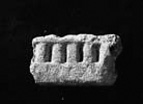
Object type: Fragment of frieze
Measurements: H. 7 > 6 cm (2.8 > 2.4 in); W. 12 >10 cm (4.7 > 3.9 in); D. 2.8 > 1.5 cm (1.1 > 0.6 in)
Stone type: Pale yellowish-grey, medium-grained, very shelly, oolitic limestone; Combe Down Oolite, Great Oolite Formation of the Bath area, Great Oolite Group, Middle Jurassic
Plate numbers in printed volume: Ills. 560-561
Corpus volume reference: Vol 4 p. 291-292
(There may be more views or larger images available for this item. Click on the thumbnail image to view.)
The fragment consists of a row of dentils framed by flat borders. The lower border (as shown in Ill. 561) is 2.6 cm wide and carries possible traces of the original tooling in the form of barely discernable steep zig-zag markings. The dentils are 2.6 cm high, between deeply angled slots, 0.5 cm wide. The bases of the slots contain a little plaster or whitewash. The point of the tool used to split the stone has corroded into one of the slots. On the lower bed face about 2 cm behind the carved face and parallel to it, a groove, 3 mm deep, has barely survived. It may be like that on Winchester (Old Minster) nos. 44 and 47.
The present piece is like Winchester (Old Minster) no. 44, which was found in rubble above the nave (immediately to the south of the Old Minster baptistery). WS 445, found near-by in an equivalent rubble, is a more damaged fragment of a similar pattern (not further discussed). No. 37 is thus one of several fragments of border patterns or friezes with dentils. For further discussion see Winchester (Old Minster) no. 36.
It is also possible that no. 37 is part of an elaborate string-course, projecting 2 cm from the wall face. For further discussion and references see Winchester (Old Minster) no. 47.
