Select a site alphabetically from the choices shown in the box below. Alternatively, browse sculptural examples using the Forward/Back buttons.
Chapters for this volume, along with copies of original in-text images, are available here.


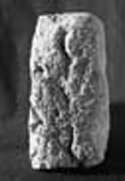
Object type: Fragment of frame
Measurements: H. 21 cm (8.3 in); W. 9 > 7.5 cm (3.5 > 3 in); D. 22.5 > 16 cm (8.9 > 6.3 in)
Stone type: Combe Down Oolite, Great Oolite Formation of the Bath area, Great Oolite Group, Middle Jurassic
Plate numbers in printed volume: Fig. 41; Ills. 574-575
Corpus volume reference: Vol 4 p. 294-295
(There may be more views or larger images available for this item. Click on the thumbnail image to view.)
The stone is roughly cut into shape to be reused as a slab in a medieval cist grave. The surviving original bed face is taken as being the top of the stone. The surfaces are damaged, but not by wear. Neither the step nor the face with guilloche are at right angles to the original bed face, but the line between the clear stone surface and the finely rendered surface on the step side is at right angles to the bed face.
A: There is a frame, 4 cm wide, to the right, flanking part of a three-strand guilloche composed of flat bands, 3 cm wide. The surviving section of the pattern is 4–5 cm wide. The relief is 16 mm deep. Thick whitewash survives in the grooves, in one place overlain by pink, tile-mixed mortar.
B: A step, 22 mm deep, lies 11 cm away from the corner at the top, and about 8.5 cm away from the (broken) corner at the bottom. The step is thus diagonal to face A. Thick whitewash survives in the angle of the step, which is slightly undercut. About 15 cm from the top of the stone the whitewash overlaps and covers the surface of a fillet of pale yellow mortar, c. 5 mm wide, containing occasional tile flecks. The thick whitewash does not extend behind this mortar: in other words, when the thick whitewash was applied, the lower 5 cm of the step had already had mortar added, bringing the edge of the step nearer the lower (now broken) corner of the stone. From this corner there is an area, 5 cm wide at the top and 4 cm wide at the bottom, which is clear stone, with chisel marks visible, but entirely without any render. Between this area and the step the stone has a fine render, pale yellow in colour, finished with a very thin layer of whitewash. This render runs below the fillet of mortar in the step and has one surviving splash of the pale yellow mortar with tile flecks, with its associated thick whitewash. The top of the step is pink in places, probably because it had been painted, perhaps directly on the stone.
