Volume 4: South-East England
Select a site alphabetically from the choices shown in the box below. Alternatively, browse sculptural examples using the Forward/Back buttons.
Chapters for this volume, along with copies of original in-text images, are available here.
Current Display: Winchester (Old Minster) 54, Hampshire 

Overview
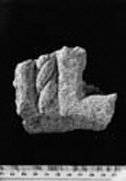
Object type: Fragment with human figure(?)
Measurements: H. 8.5 > 3.5 cm (3.3 > 1.4 in); W. 9.5 > 4 cm (3.7 > 1.6 in); D. 4.2 > 1 cm (1.7 > 0.4 in)
Stone type: Greyish-yellow, medium-grained, oolitic limestone; Combe Down Oolite, Great Oolite Formation of the Bath area, Great Oolite Group, Middle Jurassic
Plate numbers in printed volume: Ill. 583
Corpus volume reference: Vol 4 p. 299-300
(There may be more views or larger images available for this item. Click on the thumbnail image to view.)
Present Location
Winchester City Museum, Historic Resources Centre, Hyde House, Winchester, accessions no. 2943 WS 200
Evidence for Discovery
Found in archaeological excavation north of Winchester cathedral in 1964 in rubble deriving from Old Minster baptistery; Final Phase 60-6 (Provisional Phase 1965), late eleventh- to early twelfth-century
Church Dedication
Old Minster
Present Condition
No bed or dressed faces survive. The carved surface is well preserved, and white render and whitewash are present in the grooves.
Description
The inner element of this relief is what appears to be a bent arm. This consists of a vertical upper arm sloping slightly upwards, 6 cm of which survives, with rounded muscles, and a horizontal lower arm expanding into the palm of the hand, which is open but broken away where the fingers should start, measuring (from the point of the elbow to the broken edge) about 7 cm. A small part of the background is preserved behind the crook of the arm. To the left of the arm there is a vertical Z-twisted cable, each strand almost half-round and half the total diameter of the cable. To the left of the cable there is an uneven rounded moulding, which may be widening in its upper part, and is not unlike the raised arm. There is no sign of any continuation to the left of this, other than that of the background surface.
Discussion
This is a fragment of a complex carving with part of one figure and perhaps traces of a second. The quality of the carving, as shown by the cable, is very high. The arm may be that of a person praying with raised arms, as shown on the sarcophagus of Agilbert (d. 667) in Jouarre (de Maillé 1971, 195–216, figs. 75–82, 86). The arms on the sarcophagus are much the same size as the possible arm on the present carving, but the Jouarre arms are raised higher and the upper arms are therefore at a steeper slope. Significantly, the mandorla of Christ in Majesty on the Jouarre sarcophagus is composed of an opposed twist much less three-dimensional than the cable on the present carving; on a sarcophagus from Ecija, Spain, however, the upper arms more closely resemble it. A similar arm position can be seen on the Repton stone, perhaps of the eighth century, where the arms are raised in a triumphant gesture. The Repton figure is, however, twice as large and clad in mail. The nearest parallel is to be seen in the arms of the prostrate figure on Winchester (Old Minster) no. 88 (Ill. 646).
Date
Seventh to ninth century or later
References
Biddle and Kjølbye-Biddle forthcoming a, fig. 147, no. 55
M.B.; B.K.-B.
Endnotes
