Select a site alphabetically from the choices shown in the box below. Alternatively, browse sculptural examples using the Forward/Back buttons.
Chapters for this volume, along with copies of original in-text images, are available here.


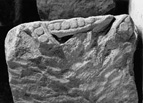
Object type: Part of frieze
Measurements: H. 70.4 > 7.2 cm (27.7 > 2.8 in); W. 33.5 > 31 cm (13.2 > 12.2 in); D. 79.2 > 13.6 cm (31.2 > 5.4 in)
Stone type: Yellow-brown (10YR 8/4), medium- to coarse-grained, shelly, oolitic limestone; Combe Down Oolite, Great Oolite Formation of the Bath area, Great Oolite Group, Middle Jurassic
Plate numbers in printed volume: Ills. 592
Corpus volume reference: Vol 4 p. 303
(There may be more views or larger images available for this item. Click on the thumbnail image to view.)
The stone was originally an ashlar measuring c. 79 cm by c. 70 cm, and 33 cm in thickness. It has two stages of secondary working, first seen in the trimming back of the carved surface by a sloping, but almost vertical face about 20 cm wide. This meets a sloping face, 39 cm long, which ends about 25 cm from the back of the stone in the original bed face. The same tooling as the recut sloping face has also cut away some of the same dressed face quite roughly. This tooling is made by a wide instrument, probably an adze, and is of Anglo-Saxon type. The original dressed face has also been cut by a (probably Norman) chamfer 11 cm (4.3 in) wide. This chamfer ends in a vertical face which cuts the earlier secondary tooling. The interlace bands are almost 5 cm wide with a central strip, 3.5 cm wide, subdivided into well-defined flat, rounded pellets (diameter, 2–2.5 cm). The carving is about 1 cm deep.
