Select a site alphabetically from the choices shown in the box below. Alternatively, browse sculptural examples using the Forward/Back buttons.
Chapters for this volume, along with copies of original in-text images, are available here.


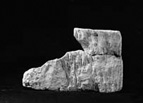
Object type: Part of frieze, in two joining pieces
Measurements: H. 13.5 > 5 cm (5.3 > 2 in); W. 48.5 > 10.5 cm (19.1 > 4.1 in); D. 22 > 10 cm (8.7 > 3.9 in)
Stone type: Medium light grey, fine-grained, slightly silty, moderately hard limestone; Lower Chalk, Chalk group, Upper Cretaceous; perhaps from Chilcombe inlier, near Winchester
Plate numbers in printed volume: Ills. 600-602
Corpus volume reference: Vol 4 p. 304
(There may be more views or larger images available for this item. Click on the thumbnail image to view.)
A: A border, 1.5–2 cm wide, surrounds the interlace on at least three sides. A pelleted band, c. 3 cm wide, forms an oval interlacing with a strand or strands crossing almost at right angles in the middle of the loop. There are hints of further complications to the right.1]
D, E, and F: The surviving parts of the dressed faces have crisp chisel marks, 1–1.5 cm wide.
