Select a site alphabetically from the choices shown in the box below. Alternatively, browse sculptural examples using the Forward/Back buttons.
Chapters for this volume, along with copies of original in-text images, are available here.


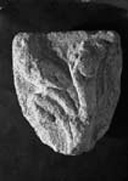
Object type: Foliate fragment
Measurements: H. 28 > 16 cm (11 > 6.3 in); W. 24 > 12 cm (9.4 > 4.7 in); D. 19 > 18 cm (7.5 > 7.1 in)
Stone type: Combe Down Oolite, Great Oolite Formation of the Bath area, Great Oolite Group, Middle Jurassic
Plate numbers in printed volume: Ill. 615
Corpus volume reference: Vol 4 p. 307-308
(There may be more views or larger images available for this item. Click on the thumbnail image to view.)
Only one face is carved.
A: This is an element of a relief including a larger than life acanthus. It is described as if the stem is at the bottom and the leaves spread out at the top. Part of the plant pattern was secondarily isolated so that it is the motif of a label, basically rectangular but with an asymmetrical triangular bottom, a steep left side, c. 7 cm high, a flat middle part, c. 9 cm wide, and a less steep, slightly curved right side, c. 7 cm high at the front and c. 10 cm high at the back. The left side has a smooth area, gently curved from top to bottom and slightly sloped from back to front, possibly as a result of the secondary tooling on this side. The bottom slopes up from front to back, and slightly down toward the right. The bottom face meets the left side in a bevel, c. 2.5 cm wide, but meets the right side in a sharp angle. The lower part of the right side is slightly curved and slopes down toward the back. This concave surface is very smooth and may be original. The way it meets the bottom facet could suggest that the latter also, although not so smooth, is primary. The right side has wide chisel marks, is quite rough, and slightly bulging, apart from a small area at the bottom, joining the concave part, which is smooth and slopes slightly outward. The smooth part of the left side as well as the bevel may also be original.
The relief is up to 3.5 cm deep, and the plant fills the whole height of the stone. Where the original surface survives, it is beautifully finished. The acanthus has a central stem, c. 4 cm wide at the bottom, which splits into three elements. To the bottom left is a well preserved tripartite leaf with only the lower point damaged. The central stem flares to the left and at the top left corner curves sharply back toward the middle, but its upper part is missing. The third element curves gently up into the top right corner; its outline is clear, but the upper surface is badly damaged. The background areas, where they could be easily reached, are smooth, as are the vertical sides of the plant, whereas in the middle of the top, where access was difficult, the finish is more irregular with individual tool marks visible. The finish along the top and on the left is smooth, in the middle and on the right rough, suggesting that there once was some further element on the right, a fragment of which may survive at the bottom right corner.
C and E: The back and top are well finished and smooth with fairly narrow chisel marks and a chalky slightly smothered feel; these may be original.
B and D (sides): The two sides are more irregular, with a distinctive orange colour in some of the secondarily tooled areas. Wide smooth chisel marks survive giving a bevelled impression near the front. The left side is at right angles to the carved surface for the first 3–4 cm and then slopes inwards; the right side is more damaged, but has a deeper area at right angles to the carved surface and a smaller, not very distinctive, inward slope at the back. The left side is as a whole clearly curved; the right side may have been similar, but it is difficult to be sure.
It is impossible to be sure which way round this carving was originally intended to be seen, but if the stone is placed as here described, the carved face slopes noticeably backwards and the relief is dead, whereas if the stone is placed with the rectangular upper bed face at the bottom, the relief is vertical and springs to life. When the block was recut to its present shape, the intention seems to have been to display the plant upright (as shown in Ill. 615), with the re-cut triangular part of the stone at the bottom. This piece belongs with the other three-dimensional fragments of Winchester style sculpture, Winchester (Old Minster) nos. 67–70, all probably deriving from the late tenth-century eastern apse. The present carving may have had two Anglo-Saxon uses, since all the tooling on it is of Anglo-Saxon character. Its primary shape cannot be determined but involves the right side. In its reused form the stone may have been part of a larger scheme or could have been set as an individual decorative label. Similar floral elements can be seen in the Benedictional of St Aethelwold, where an acanthus of this type can be seen on its side on fol. 92v (reproduced in Warner and Wilson 1910).
This stone was built into the thirteenth-century western boundary wall of the medieval Paradise cemetery: it might therefore have come from the tenth-century westwork, but could have come from any part of the Old or New Minsters.
