Volume 4: South-East England
Select a site alphabetically from the choices shown in the box below. Alternatively, browse sculptural examples using the Forward/Back buttons.
Chapters for this volume, along with copies of original in-text images, are available here.
Current Display: Winchester (Old Minster) 79, Hampshire 

Overview
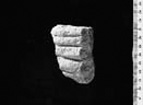
Object type: Figural fragment
Measurements: H. 7 > 3.5 cm (2.7 > 1.4 in); W. 5.5 > 4 cm (2.2 > 1.6 in); D. 2.5 > 1 cm (1 > 0.4 in)
Stone type: Pale greyish-yellow, medium- to coarse-grained, oolitic limestone, with calcite veinlet; Combe Down Oolite, Great Oolite Formation of the Bath area, Great Oolite Group, Middle Jurassic
Plate numbers in printed volume: Ill. 620
Corpus volume reference: Vol 4 p. 311
(There may be more views or larger images available for this item. Click on the thumbnail image to view.)
Present Location
Winchester City Museum, Historic Resources Centre, Hyde House, Winchester, accessions no. 2943 WS 22
Evidence for Discovery
Found in archaeological excavation north of Winchester cathedral in 1965 in rubble deriving from the demolition of the south wall of New Minster; Final Phase 67 (Provisional Phase 736), c. 1110
Church Dedication
Old Minster
Present Condition
One bed face survives at the top; the carved surface is somewhat battered, and there are traces of whitewash.
Description
This is the inside of a clenched right hand, carved at about two-thirds life size. The distal end of the little finger and parts of the other three fingers and the thumb can be seen. The palm of the hand can never have been shown in full since the fingers are overridden, at least in part, by another element, which cannot be understood.
Discussion
This fragment was found in the robber-trench of the south wall of New Minster but it could derive from the tenth-century east end of Old Minster, immediately south of this part of the New Minster robbing, with which similar pieces (Winchester (Old Minster) nos. 80–1 and 88) are probably to be associated (see Chap. VIII; and no. 88). Similar to the hands on Winchester (Old Minster) no. 88 (Ill. 646) and probably from a comparable relief.
Date
Late tenth to early eleventh century
References
Biddle and Kjølbye-Biddle forthcoming a, fig. 151, no. 80
M.B.; B.K.-B.
Endnotes
