Select a site alphabetically from the choices shown in the box below. Alternatively, browse sculptural examples using the Forward/Back buttons.
Chapters for this volume, along with copies of original in-text images, are available here.


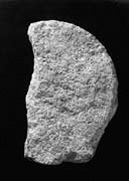
Object type: Round-topped grave-marker
Measurements: H. 39 > 38 cm (15.4 > 15 in); W. 26 > 9 cm (10.2 > 3.5 in); D. 9.6 > 7.5 cm (3.8 > 3 in)
Stone type: Pale grey, porous, shell-fragment limestone; Quarr stone, Bembridge Formation, Palaeogene, Tertiary; Isle of Wight
Plate numbers in printed volume: Ills. 673-675
Corpus volume reference: Vol 4 p. 330
(There may be more views or larger images available for this item. Click on the thumbnail image to view.)
This is the left side of a rounded grave-marker sitting on a narrower neck. The rounded upper part forms more than a semicircle, being gathered in towards the lower edge of the frame.
A (broad): The carving is recessed 2.4 cm deep within an arched area, the surface of which is level with the surface of the frame and neck. The bottom of the recessed area forms a straight line. A Hand of God, palm outwards, comes down out of what appears to be a cloud, which may have had its surface at the level of the frame. The Hand is in a blessing gesture with the second and third fingers extended and the thumb lying on top, and it holds a horizontal cross with the head to the left. The cross has expanded arms, like the cross on Winchester (New Minster) 1 and probably also had parallel lines on each arm (Ill. 657).
The carving is very damaged but looks as if it was of good quality, like Winchester (New Minster) no. 1, and better than Winchester (Old Minster) no. 2 (Ill. 498). All the dimensions are smaller than those on New Minster no. 1, which did not apparently have a narrower neck (Ill. 657). No rounded central area survives on the cross of the present piece, but there is perhaps a hint that there was once a central boss. The remains of a setting-out point survive in the middle of the palm of the hand, 18.5 cm (7.3 in) from the outer edges of the external curve. There may be another setting-out point in the head of the cross. For further discussion about hand position and the holding of a cross, see Old Minster 2 and New Minster 1.
It is possible to suggest where this stone may originally have come from, although it was found as rubble in a late foundation in St Pancras's Church. On the Lower Brook Street site there were two churches, St Mary and St Pancras. There were no Late Saxon graves around St Mary's, but at St Pancras three graves were found which were earlier than the context of the present piece: two were Anglo-Saxon (G.20 inside the church and not disturbed; and G.21 south of the church and cut by the first south porticus), and one perhaps of early twelfth-century date (G.17). This grave-marker could have come from G.21, where it would have been disturbed when the first south porticus was built in the early eleventh century; ultimately it found its way into the foundation of a later medieval bell-turret together with pink brick-filled plaster (or 'somp') of Anglo-Saxon type, which could have come from the demolition of the Anglo-Saxon south (or north) porticus, along with the present (already reused) carving.
