Select a site alphabetically from the choices shown in the box below. Alternatively, browse sculptural examples using the Forward/Back buttons.
Chapters for this volume, along with copies of original in-text images, are available here.


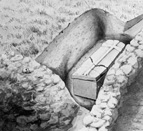
Object type: Coffin lid, in four joining pieces
Measurements: L. 216 cm (85 in); (W. 71 cm (28 in); D. 17.5 cm (6.9 in)
Stone type: Greyish-yellow, medium- to coarse-grained, shelly, oolitic limestone; Barnack stone, Lincolnshire Limestone Formation, Inferior Oolite Group, Middle Jurassic
Plate numbers in printed volume: Ill. 355-357
Corpus volume reference: Vol 4 p. 230-231
(There may be more views or larger images available for this item. Click on the thumbnail image to view.)
The lid is tapering and slightly coped. Only the upper surface is carved.
A (top): Decorated with a low-relief Latin cross. The expanding head and horizontal limbs terminate on the edges of the face. The foot is parallel sided and divides into two tapering, out-turned tendrils flanking a pointed axial growth which touches the foot of the stone.
When in use it seems clear that the lid was visible on the ground surface, covering an elaborately sculpted, re-used Roman coffin containing the burial, which was sunk into the ground. The use of a stone coffin may be an indicator of a relatively high status or prosperity; St Aethelthryth of Ely, for example, was buried in a Roman coffin brought from Grantchester, Cambridgeshire (Bede 1969, 395 (iv, 19)). In Anglo-Saxon England in general burial in stone coffins is unusual, but a number, with or without surviving lids, are known from the Old Minster, Winchester, from the area around the monument which Biddle has identified as marking the original burial place of St Swithun (Biddle 1967a, pls. LIII and LIVb; idem 1970, 317–21, fig. 12). There are other stone coffins in the cemetery outside the east end of the Minster and another in the nave (Biddle 1970, fig. 12). The prestigious position of many of these coffins reinforces the suggestion that a stone coffin may be an indicator of status. Confirmation comes from the rural cemetery at Raunds, Northamptonshire, where, despite the almost total excavation of the cemetery, only a single stone coffin has been found, again in a prestigious position in front of the south door of the church. The cemeteries at both Winchester and Raunds also contained a number of cist burials, and the discovery of two cist burials oriented east–west near the stone coffin at Westminster may suggest that the nineteenth-century works at the abbey disturbed part of the pre-Conquest graveyard.
In general form the decoration on the lid resembles that of the Sussex and Surrey grave-covers, for which an eleventh-century date can be argued on archaeological grounds. The foliated foot is treated in a manner reminiscent of a pilaster base at Corhampton, Hampshire (no. 2; Ill. 440), for which a tenth- to eleventh-century date has been argued. Certainly, the building of Westminster abbey by Edward the Confessor, beginning c. 1050, does not provide a terminus post quem for the slab, as there was a monastic community here at an earlier date (Hunting 1981, 14–19).
