Select a site alphabetically from the choices shown in the box below. Alternatively, browse sculptural examples using the Forward/Back buttons.
Chapters for this volume, along with copies of original in-text images, are available here.


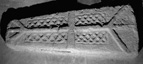
Object type: Grave-cover [1]
Measurements: L. 180 cm (71 in); (W. 65 cm (25.6 in); D. 13 cm (5 in)
Stone type: Pale grey to brownish-grey, medium-grained, coarsely shelly, oolitic limestone; Barnack stone, Lincolnshire Limestone Formation, Inferior Oolite Group, Middle Jurassic
Plate numbers in printed volume: Ill. 361
Corpus volume reference: Vol 4 p. 232
(There may be more views or larger images available for this item. Click on the thumbnail image to view.)
The cover tapers pronouncedly. Only the upper surface is carved.
A (top): A high-relief central moulding of rectangular section is crossed at the mid-point by a second similar moulding spanning the width of the cover. Flanking the median moulding, leaving broad plain borders on the long edges, are two pairs of narrow, rectangular fields, ornamented in low relief. Those at the broad end contain four-strand plain plaits; those in the longer and narrower panels are three-strand. Their inner ends terminate on the cross piece, while their outer ends stop about a fifth of the way in from each end. Beyond, pairs of high relief mouldings of square section emerge from the median moulding and run towards the corners. Along the narrow ends of the cover are damaged, low-relief, plain borders.
