Select a site alphabetically from the choices shown in the box below. Alternatively, browse sculptural examples using the Forward/Back buttons.
Chapters for this volume, along with copies of original in-text images, are available here.


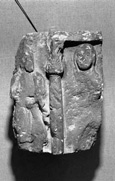
Object type: Cross-shaft, in five pieces [1]
Measurements:
Fragment a: H. 38 cm (15 in); W. 44 cm (17.3 in); Diameter (reconstructed) c. 53 cm (18 in)
Fragment b: H. 32 cm (12.6 in); W. 25 cm (9.8 in); Diameter (reconstructed) c. 46 cm (18 in)
Fragment c: H. 29.5 cm (11.6 in); W. 23 in (9 cm); Diameter (reconstructed) c. 46 cm (18 in)
Fragment d: H. 30 cm (11.8 in); W. 28 cm (11 in); Diameter (reconstructed) c. 46 cm (18 in)
Fragment e: H. 29 cm (11.4 in); W. 26 cm (10.25 in); Diameter (reconstructed) 38 cm (15 in)
Stone type: Greyish-white, finely granular limestone; some stones include moulds of gastropods and bivalves, and all except fragment c include Serpulid worm tubes; Ditrupa limestone, Calcaire Grossier Formation, Palaeogene, Tertiary; Paris Basin
Plate numbers in printed volume: Ills. 111-120
Corpus volume reference: Vol 4 p. 151-161
(There may be more views or larger images available for this item. Click on the thumbnail image to view.)
Each fragment forms part of the drum of a cylindrical shaft. All except fragment d retain traces of paint.
Fragment a: Dressed flat below, but broken above and to the rear. The decorated face is divided into four fields (numbered (i)–(iv) from left to right) by three damaged, vertical mouldings originally of square section. These are rebated to take narrow, rectangular, metal fittings. The median moulding also has two pairs of pin holes. Only a marginal undecorated fragment of field (i) survives. In field (ii) is a frontally placed robed figure, surviving from waist level to just below the knee. The left leg is bent at the knee, the right leg is straight. The figure's left hand is held at waist level, and it wears a long robe, over which is a shorter garment falling in a series of folds from left to right, with a portion of it falling in a series of vertical folds beside each frame. In field (iii) the figure is similarly posed, and survives from mid-torso to just below the ankle. The figure is robed like that in field b, but the full-length robe stops just above the ankles which are bare. The shorter overgarment is gathered up across the body and the end flung over the left arm of the figure to fall vertically beside the frame. The folds of the garment across the body are suggested by incised lines, and where the robe falls over the arm its edge is paralleled by a pair of incised lines. The left hand of the figure is held at waist level and holds a partially open scroll. The fragmentary field (iv) contains part of a similar frontally-placed robed figure, with portions of its robe falling in vertical folds beside the frame. Traces of paint survive, often applied on a thin plaster ground. Red is used for the background with a dark blue on the robes of the figures. In some cases vertical folds are alternately red and blue.
Fragment b: Dressed flat above and below, and broken to each side so that it roughly tapers. A curved moulding of square section runs along the right-hand edge of the drum before running off towards the mid-point of the lower edge. To its left are three small rounded hillocks diminishing in size from right to left, on which stands a robed, barefoot figure, cut off at shoulder level and incomplete to the left. The figure is half-turned to the right, with its left leg bent at the knee, and the foot, in profile, placed on the largest of the hillocks. The right leg is straight, and the foot placed frontally on the smallest of the hillocks. The heavily-damaged right arm of the figure is raised, and the left arm is held out straight, with a hole drilled through the palm of the hand. The figure wears a long robe reaching down to mid-calf level, and with a folded hem. Over this is a shorter robe reaching to the knee and having a straight hem. There is a sash at the waist, and a fold of the garment is draped over the left arm. A second fragmentary, robed, barefoot figure stands on the ground to the right, and leans to the left, behind and beyond the frame. The figure wears an ankle-length robe which has a folded hem. In the ankle is a drilled hole. Traces of paint survive, often applied on a thin plaster ground. Red is used for the background, blue for the robes.
Fragment c: Dressed flat above and below, and roughly broken to each side. It is decorated with a barefoot, robed figure, in profile, cut off at chest level, and leaning to the right with its left foot flat on the ground and its right foot half raised. The figure wears a long robe terminating at mid-calf level in an undulating hem which is paralleled by an incised line. Over this is a second robe of similar length gathered across the body to the right, incised lines suggesting the folds. The figure is winged. In front of the figure is a plain rectangular block on top of which is a swirling device, possibly a flame. A hand, palm outwards, develops from the lower right in front of the block. To the left of the figure is the garment edge and part of the wing of a second figure. Between the two figures, at thigh level, is a disc-shaped object. Traces of paint survive, often applied on a thin plaster ground. Red is used for the background, blue for the robes.
Fragment d: Dressed flat above, below, and to the right, but roughly broken to the left. The face is divided into two unequal fields by a three-quarter round column, the damaged capital of which is decorated with a large, upright, veined, serrated leaf. Incised lines suggest the veins. From behind this a volute emerges to the right. The capital is damaged to the left. In the smaller field to the left is an incomplete, bearded, robed figure, with its long hair falling onto the right shoulder. The figure is cut off at mid-calf level, and is damaged to the left. It looks and is half-turned to the right, with the left leg bent at the knee. The left arm rests on the waist, and the damaged right arm, bent at the elbow, is raised across the right side of the body. The figure wears a full-length robe, over which is a knee-length garment. The folds over the body are suggested by incised lines. Part of the robe is flung over the left shoulder of the figure and falls beside the flanking column to mid-thigh level. In the field to the right only the head of the figure survives, placed frontally and turned slightly to the left. Over the head is a cloth. The eyes are drilled.
Fragment e: Dressed flat above and below, but roughly broken to the left and right. The face is divided into two unequal and incomplete fields by a wide, vertical interlace border of half pattern D, flanked by mouldings of square section. This unites with a horizontal interlace border along the upper edge of the drum. The plain mouldings are returned to parallel the upper edge of the drum. In the fragmentary field to the left only a wing survives, curving round in the upper corner of the panel and carried down beside the plain moulding to the right to terminate in a point near the lower edge of the stone. There is a rectangular figure at waist level. In the field to the right the plain binding of the stem of a plant-scroll enters from the lower right, and from it emerges a stem which is carried across to touch the plain frame before curling back on itself and being brought round to touch the binding again. Here the tip curls to the right, and the stem terminates in a single-lobed, pointed leaf, with incised lines suggesting the veins. The back of the leaf rests on the binding. The stem encloses a frontally-placed bust with curly hair, and with the eyes outlined by incised lines and having drilled pupils. The bust is clothed in a round-necked garment, with an incised line paralleling the opening. Over the shoulders is a cloak from behind which the left arm emerges. The hand is placed palm inwards on the right breast. On the shoulders of the bust rest groups of narrow, expanding leaves developing from the encircling stem. Below a similar group of leaves emerges from the binding to curl down and over the head of a second bust, like the first, but cut off at nose level. In the angle between the upward and downward curling stems a small stem issuing from the binding is carried across to touch the frame before curling up and over to terminate in a leaf like that on the end of the upper main stem. A similar leaf lies next to the head of the lower bust, and to its right. There are extensive traces of a plaster ground. The background areas are painted red.1
