Select a site alphabetically from the choices shown in the box below. Alternatively, browse sculptural examples using the Forward/Back buttons.
Chapters for this volume, along with copies of original in-text images, are available here.


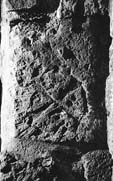
Object type: Part of grave-marker or -cover
Measurements: H. 37 cm(14.5 in) W. 32 cm (12.5 in) D.27cm (10.5 in)
Stone type: Olive grey (2.5Y 6/2) to brownish-yellow (10YR 6/6), cavernous-weathered, ferruginous limestone, with scattered goethite ooliths of 0.3mm diameter, some represented by their vacated sockets, and some shell fragments. Tealby Limestone, Lower Cretaceous of Lincolnshire
Plate numbers in printed volume: Ill. 397
Corpus volume reference: Vol 5 p. 279
(There may be more views or larger images available for this item. Click on the thumbnail image to view.)
Only the part of one decorated broad face now visible in the reveal of the doorway is certainly original. The remainder may have been recut for the reuse and four sides are built in. There is a simple chamfer cut along the free arris as moulding for the doorway.
A (broad): Decorated in low relief with a cross of type E6 set within an incised circle of 19 cm (7.5 in) diameter.
Appendix A item (stones dating from Saxo-Norman overlap period or of uncertain date).
The form of the original monument is not certain. If a marker, it is clearly not the disc-head and shouldered type of the pair at Beelsby (nos. 1 and 2, Ills. 392, 394) and at Cabourne (no. 1, Ill. 396), and is likely to have been a simple rectangular form. But the E6 (or E8) cross-type is found locally on Beelsby 1 and Cabourne 1, despite the different monument shape. Simple markers of this decorative type are known in north-east England, as at Norham 18 (Cramp 1984, pl. 248, 1374) and Woodhorn 3 (ibid., pls. 257, 1401 and 258, 1403), and have been assessed as of later eleventh century or more generally overlap date. The local Lindsey examples are standardly in Tealby Limestone, whose use is typically post-Conquest. The reuse of this piece and Hawerby 2 (q.v.) may give a thirteenth-century terminus ante quem.
