Select a site alphabetically from the choices shown in the box below. Alternatively, browse sculptural examples using the Forward/Back buttons.
Chapters for this volume, along with copies of original in-text images, are available here.


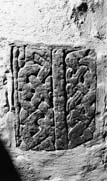
Object type: Part of grave-cover
Measurements: L. 43 cm (17 in) W. 32 cm (12.5 in) D. Built in
Stone type: Greyish pink (5YR 7/4), medium grained quartzose sandstone, evenly graded, consisting of closely packed subangular quartz grains around 0.3mm diameter, some apparently with euhedral quartz faces (possibly crystal overgrowths), and with argillaceous material in the interstices between quartz grains. Like Thornton Curtis 1, typically reddened Millstone Grit from the junction of the Upper Carboniferous and the overlying Permian in the Knaresborough area.
Plate numbers in printed volume: Ill. 203
Corpus volume reference: Vol 5 p. 178-180
(There may be more views or larger images available for this item. Click on the thumbnail image to view.)
Part of the middle section of a flat grave-cover with no marked taper, decorated on its upper surface in low relief. Both ends of the slab are broken and the right side is damaged.
A (broad): The decoration comprises two runs of interlace apparently of different form and unequal width, separated by a plain flat rib, presumably the stem of a cross. In both runs the strands have traces of double incised medial lines or animal contouring. On the left at the top are two sharply angled strands which may be the lower part of an animal. Below this is a run of interlace commencing with a pattern C loop, but changing to interlocking half pattern D knots with long loops and included terminals. Each long loop is crossed by two parallel diagonal strands forming the other loop. A narrow roll border survives along the outer edge of this run that exhibits traces of cabling. In the other panel at the top is a sharply angled strand which may be the lower part of an animal. Below this is a narrower run of interlace commencing with a pattern F loop. The interlace resembles three-strand plait but the crossings are very worn and some of the strands appear to bifurcate. Since the edge of the stone has been removed along this side, it is possible that this was actually four-strand plait, whose mutilation makes it difficult to read. It would then match the other run, which it otherwise resembles closely.
The decoration of this cover finds no analogies in the bulk of covers from Lincolnshire: its material is also alien and suggests connections north and west. With the decoration correctly understood as matching runs of zoomorphic interlace filling fields either side of a cross-shaft, it becomes clearly and specifically recognisable as part of a York cover and a product of the Metropolitan school there (Lang 1991, 39–40). Its best parallels lie in that remarkable group of flat covers of tenth-century date from York (Pattison 1973, 223–4, pl. XLVIII; Lang 1978c, 20), which includes examples from All Saints Pavement, St Denys Walmsgate, St Mary Bishophill Junior and St Olave/ St Mary's Abbey in addition to the covers found in situ with burials 2, 9 and 11 in the cemetery under the Minster (Lang 1991, ills. 148, 152, 158, 159, 201, 206, 238, 361–4). It shares with that group the rather narrow overall width (calculated as 35cm/13.5in here), the narrow cabled border, two fields of interlace with incised lines or contouring divided by a plain cross stem, and four-strand plait that develops into some sort of complexity, that at York is typically Jellinge-style animals' heads below the cross-arms and at the foot of the cover (Ill. 478). Holton le Clay 1 has been split for reuse just short of the point where animal terminals develop from the plait and are recognisable. The double contoured ribbons relate to that Jellinge-derived zoomorphic form.
The stone type, like that of Crowle 1 and Thornton Curtis 1, reinforces the York connection, since the city was the source for a redistribution of Roman masonry in the later pre-Conquest period (Morris 1988; and see Buckland 1988).
As part of a York cover, this piece has exceptional interest in the chronology and socio-economic development of Anglo-Scandinavian settlement in northern Lincolnshire. It indicates the southward movement of Metropolitan workshop products in a riverine and coastal pattern, just as the piece from Gainford on Tees marks export northwards (Cramp 1984, 86–7, pl. 69, 343). Lang has argued the close link between the activity of the Metropolitan school and the existence of the Viking kingdom of York, giving a date bracket for its floruit of c. 870 to c. 940, most probably focusing in the early tenth century. This places Holton 1 in the same chronological context as the cross-shaft at Crowle, and arguably exhibiting similar social and economic connections of Scandinavian lordship looking to the political power of York. It certainly pre-dates the development of large-scale standardised production of grave-covers from indigenous materials within the county, that appears to lie in the second half of the tenth century and certainly penetrated the Grimsby area, presumably by coast-wise water transport, with examples of Lindsey covers at Laceby and North Thoresby and a mid-Kesteven cover at Humberston.
By the same token it might be expected to pre-date or presage the development of the parochial system that the evidence for a multiplicity of local graveyards can be taken to indicate. The 1975 excavations at Holton le Clay have shown that there was a regularly organised cemetery of oriented burials probably of tenth- and early eleventh-century date lying north of the church's west tower, where it occupied the top of the prominent glacial knoll on which the church stands, and perhaps extending east to the area north of the chancel (Sills 1982).[1] It may be worth considering that the cover represents a founder's grave displaced by enlargement of the church at the focal spot; that, pace Sills, the tower was in origin a tower-nave positioned on the top of the knoll, from which the later medieval church extended eastwards off the apex (Sills 1982, fig. 1); and even that the dedication to St Peter reflects the founder's affiliation with York.
[1] Early and mid Saxon pottery residual in the graves provides a terminus post quem, and associated metalwork plus the circumstance of several graves being cut by the foundations of the late eleventh-century tower underpin the excavator's assessment that they belong to the late Saxon period 'between the ninth and earlier eleventh centuries'.
