Select a site alphabetically from the choices shown in the box below. Alternatively, browse sculptural examples using the Forward/Back buttons.
Chapters for this volume, along with copies of original in-text images, are available here.


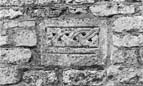
Object type: Two fragments, probably from the same grave-cover
Measurements:
a: L. 33 cm (13 in) W. 40 cm (15.7 in) D. Built in
b: L. 27 cm (10.6 in) W. 19 cm (7.5 in) D. 32 cm (12.6 in)
Stone type: [Both stones are Ancaster Freestone, Upper Lincolnshire Limestone, Inferior Oolite Group]
Plate numbers in printed volume: Fig. 9; Ills. 223–4
Corpus volume reference: Vol 5 p. 192
(There may be more views or larger images available for this item. Click on the thumbnail image to view.)
Stone 1a. The visible face is a fragment of a larger design. It has an undecorated border, within which is a complete panel of interlace in low relief. One edge of the interlace panel has a secondary border elaborated with a cable moulding inside the undecorated angle. The interlace itself is a unit of three-strand plait with two free ends, and has an incised medial line.
Stone 1b. The smaller fragment has a broad undecorated border, above which one part of an interlace knot in a run of three-strand plait is understandable. The interlace strands have a double incised medial line.
The two fragments should probably be assigned to the same original monument, both because of the close similarity of stone type and of their style of decoration. Both pieces can be reconstructed as parts of the same grave-cover of mid-Kesteven type (Fig. 9). In such a reconstruction 1a is likely to be a transverse panel at one end of the lid, whilst 1b could be a piece of interlace from the long horizontal flank panel, which is characteristically set between such upright terminal panels. Other sites might, however, be possible for 1b. The style and design of the interlace decoration is, anyway, very characteristic of the mid-Kesteven group (Chapter V), and consequently the monument represented is likely to date from the period between the mid tenth and the early eleventh century, no matter which reconstruction is preferred.
