Select a site alphabetically from the choices shown in the box below. Alternatively, browse sculptural examples using the Forward/Back buttons.
Chapters for this volume, along with copies of original in-text images, are available here.


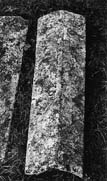
Object type: Grave-cover
Measurements: L. 192 cm (75.5 in) W. 61 > 43 cm (24 > 17 in) D. 25 > 15 cm (10 > 6 in)
Stone type: [Lincolnshire Limestone but not Ancaster or Barnack types, ?of Lincoln vicinity]
Plate numbers in printed volume: Ill. 228
Corpus volume reference: Vol 5 p. 193-194
(There may be more views or larger images available for this item. Click on the thumbnail image to view.)
A coped, tapered grave-cover, probably complete except for minor damage along one edge, and decorated on its upper surface only. Its decoration consists of a cross in relief with three wedge-shaped arms (type B6), the upper one touching the head end of the cover, and a long narrow shaft extending the full length of the ridge to the foot.
This cover and its almost identical companion from the same churchyard (Langton by Wragby 2) are included here because monuments employing a similar cross form as their sole decoration have been assessed as pre-Conquest. Examples include a grave-cover and a round-headed grave-marker from Hexham, Northumberland (nos. 14 and 16: Cramp 1984, 182–3, pls. 179, 954 and 181, 970); Cramp views the long-stemmed B6 cross in these cases as an indication of late date within the pre-Conquest period, namely late ninth to early tenth in one case and early tenth to mid eleventh in the other. Closer still in its form of cross, though with its long stem cabled, is the Viking-period cover from Cross Canonby, Cumberland (no. 4: Bailey and Cramp 1988, 89, ills. 222–3). At Peterborough and in the Cambridge region, however, coped covers with well-marked longitudinal ribs in relief, wedge-shaped cross-arms and no in-filling interlace have been taken by Fox (1920–1, 35–6) to mark a transition from eleventh-century interlaced covers to thirteenth-century coped types. Locally, the very full series of covers from excavations at St Mark's in Lincoln confirms the general currency of coped monuments, both decorated and plain, from the later eleventh to the thirteenth century (Stocker 1986a, 58–9). The cross-head type finds its securest archaeological context on the fragmentary Marton 5, reused in the fabric of the late eleventh-century church tower (Ill. 300).
The weathering of both this and Langton by Wragby 2 suggests that both stones have been exposed in the churchyard for a long time: they may in fact be in or near their original position and a contemporary pair marking related burials.
