Select a site alphabetically from the choices shown in the box below. Alternatively, browse sculptural examples using the Forward/Back buttons.
Chapters for this volume, along with copies of original in-text images, are available here.


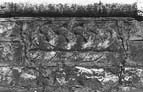
Object type: Incomplete grave-cover, in two non-adjacent pieces
Measurements:
a: L. 35 cm (13.75 in) W. 15 cm (6 in) D. Built in
b: L. 88 cm (34.75 in) W. 39 cm (15.25 in) D. Built in
Stone type: 2b, yellowish grey (10YR 8/2–3) oolite, of close-set 0.4mm ooliths projecting millet-seed fashion above the surface of the stone. No obvious shell fragments or bedding. Ancaster Freestone, Upper Lincolnshire Limestone, Inferior Oolite Group. 2a, inaccessible but probably of the same stone type
Plate numbers in printed volume: Fig. 9; Ills. 270–1
Corpus volume reference: Vol 5 p. 212-213
(There may be more views or larger images available for this item. Click on the thumbnail image to view.)
A (top): The only visible face of stone 2a is decorated with a run of four-strand plait, from one end of which a single strand emerges to link on to adjacent decoration. Alongside is a straight cable-moulded roll; this is not an original edge since stone surface survives beyond it.
B (long): Stone 2b is decorated in low relief with two horizontal runs of interlace divided from each other by a cable-moulded rib or fillet, the incisions for whose cabling continue onto the adjacent plain ground. The upper, narrower field is occupied by a run of tight three-strand plait, which develops symmetrically out of either side of a 'bull's head' (Fig. 11). The bull's head extends downwards and penetrates the line of the dividing rib, which diverts slightly around it, but does not disturb the lower run of interlace. The head is given emphasis by a pair of incised lines marking the noseband and by incised lines that cross over the nose and curve down the horns. The interlace of the broad lower panel is ornamented with a single incised medial line, and consists of a four-strand pattern that incorporates two figure-of-eight motifs (simple pattern F) and two free rings. This pattern may have been repeated symmetrically on the other side of the bull's head. The lower edge of the stone has a broad plain border and the complete end of the interlaced panel has a border that is cable-moulded on the level of the interlace.
This is probably not the end of the cover, but rather one half of a double cabled or vertical chevron run dividing the long central panel from a lost vertical end panel.
Their range of decoration, layout and workmanship show both these stones to be parts of a large flat-topped chest-like cover of mid-Kesteven type (see Chapter V and Table 4). They are probably from the same cover. 2b is certainly a section of the side panel. It shares the bull's head motif with other covers and fragments in this group (Fig. 11), and the mixture of figure-of-eight and free rings, and the use of a medial incision on the broad strands of the interlace are also typical. 2a may probably be a transverse panel from the lid of the cover (see reconstruction in Fig. 9).
If the report is correct that 2b was reused in the tower arch of later eleventh- or early twelfth-century date and owes its present exposure simply to being turned round in the Victorian restoration, then this provides the best archaeological context for this type of cover. This example might be presumed to have been a monument in the graveyard of the stone church represented by the west wall of the nave, that was cleared to enable the tower to be added (Taylor and Taylor 1965, 391–4).
