Select a site alphabetically from the choices shown in the box below. Alternatively, browse sculptural examples using the Forward/Back buttons.
Chapters for this volume, along with copies of original in-text images, are available here.


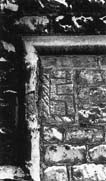
Object type: Part of grave-marker
Measurements: H. c. 30 cm (11.75 in) W. 15 cm (6 in) D. Built in
Stone type: [Inaccessible; Lincolnshire Limestone but not Ancaster or Barnack types]
Plate numbers in printed volume: Ill. 268
Corpus volume reference: Vol 5 p. 213-214
(There may be more views or larger images available for this item. Click on the thumbnail image to view.)
A fragment from the upper part of an upright rectangular grave-marker.
A (broad): The only visible face is decorated with a cable-moulded border along the two original edges, and a deeply incised double outline rectangular cross of type A1. The two arms whose full extent survive both extend to the border. The marker has been deliberately split for secondary use, in one direction approximately along one incised line of the inner cross.
This is one of the Lindsey group of closely similar rectangular markers found with a restricted distribution in Lincoln city and Lindsey (see Chapter V and Table 7A). The distinctively broad spacing of the incised double outline of this piece, which gives a clear impression of one cross within another, it shares with Lincoln Cathedral 2 (Ill. 233) and Lincoln St Mark 16 (Ill. 259) in contrast with the more strictly double outline examples in Lindsey at Gayton le Wold, Glentworth and Hackthorn 2. Unlike those two, however, its cross-arms reach laterally as well as up to the border.
The date range of the group is defined on the one hand by its potential associations with the Lindsey covers (Chapter V) and with the exceptional cover at Hackthorn, and on the other by the Glentworth example incorporated in the fabric of the presumably mid to late eleventh-century church west tower there.
