Select a site alphabetically from the choices shown in the box below. Alternatively, browse sculptural examples using the Forward/Back buttons.
Chapters for this volume, along with copies of original in-text images, are available here.


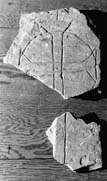
Object type: Incomplete grave-cover or -marker, in two non-adjacent pieces
Measurements:
a: L. 17 cm (6.75 in) W. 18 cm (7 in) D. 3.5 cm (1.5 in)
b: L. 11 cm (4.25 in) W. 10 cm (4 in) D. 2.5 cm (1 in)
Stone type: Pale grey, finely granular limestone (0.2mm grains), with sparse ovoid pellets up to 1.5mm in length, numerous thin shell fragments and some Modiolus-like bivalves, a few echinoid fragments, and a 3mm diameter ?coral. Cathedral Beds, Lower Lincolnshire Limestone of Lincoln vicinity
Plate numbers in printed volume: Ill. 276
Corpus volume reference: Vol 5 p. 217-218
(There may be more views or larger images available for this item. Click on the thumbnail image to view.)
Two small fragments, not conjoined, apparently from the head end (stone 1a) and the centre (stone 1b) of a small grave-cover or -marker. On both fragments the decorated surfaces have the same striated preparatory dressing, whose direction confirms the relative orientation of the pieces: their stone type is identical. Both the two unbroken edges on stone 1a are not vertical and have claw tooling. This, together with the fact that the edge at the upper end lies aslant to the decoration and also to the second surviving edge of the stone, indicates that these are recut rather than original edges of the monument, whose size and form are therefore unknown except generally from the size of the cross. All other edges are broken and the backs of both fragments are also broken surfaces.
A (top): Stone 1a bears on its upper surface a cross-head that is a hybrid of types B1 and E1 in incised outline. That is, of the three cross-arms whose full extent and form survives, the opposed pair have splayed terminals with straight outer ends (type B1) whereas the upper terminal is similarly splayed but with a curved outer end (type E1). Superimposed on the cross is a ring marked out by a single incised line of the same shallow V-form. This ring takes as its diameter the dimension of the cross member with type B1 terminals: a small hole within the intersection of the arms appears to be the compass hole from which it was struck. In consequence, the longer third arm protrudes asymmetrically beyond the ring. Outside the cross-arms in all three directions and roughly central to the arms are faint incisions that are perhaps scribe lines or marks for setting out the pattern. A similar fine incision closely parallel to one side of the vertical arm within the crossing appears also to be an earlier attempt.
Stone 1b is decorated on its upper surface only with a double incised line, perhaps representing a cross-shaft.
The whole decoration is lightly and crudely executed. The lines of the cross bar on 1a and of the shaft on 1b are notably wavy.
The claw tooling on the two dressed edges is likely to be a later medieval recutting, as the different surface dressing and angle of the edges suggest. The excavated context certainly corroborates the stones' reuse. Since the site of St Paul-in-the-Bail is one with a long ecclesiastical history that, whatever the details of its dating, includes an undoubted pre-Viking burial ground (Jones and Wacher 1987), a context exists for this piece to have been a pre-Viking monument from that episode on the site. In support of this possibility, its decorative scheme finds comparisons, for example, in general terms with early Irish grave slabs, and specifically of the large and varied class decorated with incised ringed crosses (Lionard 1961, 117–27). These predominantly belong to the eighth and ninth centuries. Among them can certainly be found examples with crosses with terminals of wedge-shaped form (type B1), as at Lismore (ibid., fig. 13.4), Kilbrecan (ibid., fig. 21.1) or Clonmacnois (ibid., fig. 17.7; pl. XXX.1), where the main concentration of this decorative group lies. Except on the very simplest incised pillars, the ring is indicated by a double line and typically has a radius less than the length of the cross-arms. Rings that take the cross-arm as their radius are found, but hybrids appear rare or nonexistent, especially since a feature of the Irish stones is their careful layout and execution. At Iona, too, there is a category of outline incised crosses with ringed heads (RCAHMS 1982, 184–9): those with inscriptions have a suggested eighth- and ninth-century date, but the type probably continued to be produced through the next century or two (ibid., 16). Horizontal cross-arms of limited projection are, of course, a common feature of Irish free-standing crosses and their analogues such as St Martin's cross on Iona (ibid., 205), but in those cases the form appears to be due to the limited width of available stone.
In contrast to the typically accurate layout and very fine execution of the early material both in Ireland and among the name-stones of north-east England (Cramp 1984), however, Lincoln St Paul 1 is both poorly made as a monument and very crudely cut in respect of its decoration. The cross type is not specifically an early one. Cross-heads of type B1 can be found decorating grave-covers of later eleventh- or twelfth-century and even later medieval date, as for example, at Repps and Bircham Tofts, Norfolk, or Bredon, Worcestershire (Boutell 1854, 18, 26, 37), and even of the fifteenth century at Blanchland, Northumberland (ibid., 57). Locally, the feet of the subsidiary crosses on the large eleventh-century cover, Howell 1, have neatly formed wedge-shaped terminals (Ill. 220). These crosses, too, have distinctively hybridised cross-head types in which a long upper arm has a wedge-shaped form with curved outer end, while the lateral arms are wedge-shaped with straight ends. At a more general level, it is precisely on grave-covers of the eleventh and early twelfth century that a tendency towards a variety of hybrids of standard cross-head forms is encountered in local products, and particularly where interlace has been eliminated from the decorative scheme entirely. The ring, too, should mark this out as a monument of the Anglo-Scandinavian period (Bailey 1980b, 70–1), of however late and derivative a form. In its sketchy execution of this motif, the piece most closely resembles the small cover, no. 14, from the St Mark's church excavations, that must itself be of later tenth- or more probably eleventh-century date (Ill. 252). In the combination of cross type, ring and execution it perhaps most directly recalls a marker from York Minster (no. 27: Lang 1991, ill. 113), whose other face has a cross not only with a stepped base of post-Conquest type but also with a good analogy in Lincoln St Mark 13 (Ill. 253–4), probably of eleventh-century date. If Lincoln St Paul 1 indeed had a fully developed long shaft, this would associate it more closely with the tradition of incised covers of the twelfth century and later.
