Select a site alphabetically from the choices shown in the box below. Alternatively, browse sculptural examples using the Forward/Back buttons.
Chapters for this volume, along with copies of original in-text images, are available here.


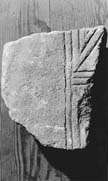
Object type: Fragment of grave-cover
Measurements:
L. 17 cm (6.75 in) W. 15 cm (6 in) D. 7 > 6.5 cm (2.75 > 2.5 in)
Stone type: Pale grey oolitic limestone with yellowish tinge, with close-packed ooliths mainly around 0.3mm diameter, in a calcite matrix; fairly numerous small (2mm) worn shell fragments; some ooliths have vacated their sockets. Possibly Ancaster Freestone, Upper Lincolnshire Limestone, Inferior Oolite Group; cf. South Kyme 1
Plate numbers in printed volume: Ill. 278
Corpus volume reference: Vol 5 p. 219-221
(There may be more views or larger images available for this item. Click on the thumbnail image to view.)
A fragment with two original faces surviving and an original edge linking them. In section it is quite thin and tapers finely and accurately from 6.5cm at the original edge to 7cm at the opposed break. Decoration is confined to one surface. It comprises a broad blank border almost 10cm wide, and the edge of a band of incised decoration apparently made up of small rectangular panels containing St Andrew's cross motifs infilled with multiple nesting triangles. The corners of two adjacent panels survive. A single continuous line creates a border between this band of decoration and the blank border, and another creates a division between the panels. The high quality of the stone allowed the cutting of the decoration to be very fine and accurate: this encourages reconstruction of the remainder of the pattern (Fig. 29). The opposite or reverse surface, though undecorated, is cut to just as fine a finish as the other.
Both functional interpretation and dating of this fragment are problematic, but it is clearly a piece of exceptional quality and originates from a special object. Its thin and finely tapering section and well-cut reverse surface all argue against its interpretation as part of a grave-cover, and the decoration cannot readily be understood in that context either. Rather it should come from an object where both surfaces are finished and potentially visible, probably as an outer decorated and an inner plain face, and where the original edge was a top surface so that the blank border and band of decoration ran horizontally. In this guise it might potentially be part of a wide range of ecclesiastical furniture, including for example an altar, screen, chest or chair (see Cramp 1984, 9–10; id. 1986). Decoration on surviving objects of this type is characteristically of fine quality, as here. Nevertheless, the apparent size of the band of decoration extending at minimum to two sections or panels in this instance suggests that the original object was large, and might most plausibly be thought of as a decorated stone coffin, of which this fragment would be a small section of the upper wall.
There is indeed evidence in Bede for the burial of persons of distinction, both royal and saintly, in the pre-Viking period in stone sarcophagi (Sebbi king of the East Saxons – Bede 1969, 366, IV.11; Etheldreda of Ely – ibid., 394, IV.19). As the story of Etheldreda's coffin demonstrates, the source of raw material or a reusable item was typically the ruins of a Roman town. Cramp has suggested that a fashion of continuing use of stone sarcophagi can be traced in the physical remains, affecting the Mercian east midlands and southern Yorkshire in the eighth and ninth centuries in a way that is not also reflected further north in Northumbria (Cramp 1977; id. 1984, 7). This assessment is based on the possible interpretation, contra previously accepted views, of decorated panels at Breedon and Castor (Cramp 1977, 210, fig. 57a–b), at Breedon again (ibid., 218, fig. 59a–c), at Hovingham, Yorkshire (ibid., 218) and Bakewell, Derbyshire (ibid., 218–19, fig. 60a), as the sides of 'box sarcophagi' that lie in a tradition also including, and perhaps drawing its decorative inspiration from, the solid shrine at Peterborough – the Hedda stone (ibid., fig. 57c) – and the fragmentary panels at South Kyme (Ills. 339–45). The most clear-cut, and on this account perhaps latest, example of this pre-Viking series in midland England is the stone sarcophagus from St Alkmund's church in Derby, which drew its decorative repertoire from a distinct and parallel Mercian tradition (Radford 1976, 45–6, pls. 4–5; Cramp 1977, 230; Wheeler 1977, 241).
On a wider canvas, the best parallels as early examples of this type of object are the range of stone and plaster coffins from sites in northern and western France, which are conventionally characterised as Merovingian and assigned a date in the sixth and seventh centuries (Salin 1952, 131–82; see also James 1977). Some, like examples from Sennecey and Molesmes, Côte-d'Or (Salin 1952, figs. 118, 119), are decorated with rows of simple and large-scale geometrical patterns; comparable motifs are also found among the numerous plaster examples from the Paris area (ibid., 172–8), and in stone also, for example, from Champagne (two examples from the Musée de St-Remi in Reims). At minimum they demonstrate that interpretation of this fragment as part of a coffin is plausible. With the extended ecclesiastical history of the site of St Paul's as known from excavations (Jones and Wacher 1987; Jones 1994), it is perhaps not impossible that a similar such elaborate object might have existed here at an early, at least pre-Viking, date. At such a date, however, a wholly geometrical decorative scheme would be quite exceptional and outside both the Insular repertoire, with its predilection for figures, and those sources upon which it otherwise drew for inspiration.
The uniqueness of such an object in England at that date, therefore, remains a problem, and considerations pointing to a rather later date and alternative context carry some weight. The decoration of the linear band finds its best local parallels in incised geometrical patterns, characterised by Butler as 'double-axe' motifs (1964, 119) on grave-covers of eleventh-century date, such as examples at Whaplode (no. 2, Ill. 386), Barnack, Soke of Peterborough, and Adel, Yorkshire WR. The fashion appears to have extended into the twelfth century on small coped covers found at Crowland (no. 1, Ill. 143) and Sleaford (no. 3, Ill. 429). The small group of 'gridded markers' of later tenth- and eleventh-century date (Chapter V) also deploys simple incised geometrical decoration, though in that instance crudely executed on monuments of the meanest sort.
If actually in effect a series of St Andrew's crosses or elaborated diaper work, the parallels become more explicitly Romanesque and extend into the early twelfth century. Most relevantly and locally they would include the fine decorated stone coffin in Lincoln Cathedral (Zarnecki 1970, 21, pl. 36a; Stocker 1986a, 62–3). This monument is not only decorated with horizontal bands of diaperwork running both above and below the interlinked circles which form the main ornamentation, but also is similarly finely cut, of similar dimensions, and of comparably high-quality stone to Lincoln St Paul 3. What sets the St Paul's piece apart is the size of the motifs and their incised execution, in contrast to the small, chip-carved work – standard Romanesque decoration, standardly executed – of the Cathedral coffin.
The distinction may be one of date. In respect of context, a further example of this monument type at St Paul's, of eleventh- probably rather than twelfth-century date, though of great interest would not be surprising or implausible, especially in the light of Stocker's clear identification of a tradition of Romanesque above-ground chest-like funerary monuments in Lincoln and the region (Stocker 1988). The ecclesiastical provision at St Paul's was developed from some form of stone cella marking the robbed grave, whose surviving original contents was the ?eighth-century hanging bowl, into a 'parish' church, presumably associated with an urban estate. This physical conversion appears to occur in the eleventh century. It might be the most plausible context for the spurt of stone sculpture represented by Lincoln St Paul 1 and 2, and also, perhaps a little later, for the more elaborate monument of which St Paul 3 is a mere fragment. The evidence from St Mark's and St Botolph's shows that other of the city's churches in the thriving suburb of Wigford were also, at least by the twelfth century, acquiring monuments of similar scale and quality.
There perhaps remains a dilemma and clear dichotomy between the two possible dates for this piece. It might belong to the seventh or eighth century, with such exceptional Merovingian affinities as to raise the possibility that direct importation might be in question. Its stone type, though undoubtedly of special quality, refutes that hypothesis, which in Lincoln anyway lacks any substantive context in the documentary or archaeological record. Alternatively and less exceptionally it may be of eleventh-century date. Here, too, direct and convincing analogies are hard to find, not least precisely because all the French material of this type is apparently routinely classified as Merovingian without any consideration of its being early Romanesque, as it appears stylistically to be.
