Select a site alphabetically from the choices shown in the box below. Alternatively, browse sculptural examples using the Forward/Back buttons.
Chapters for this volume, along with copies of original in-text images, are available here.


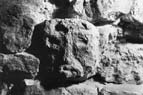
Object type: Pair of label stops
Measurements: H. c. 15.25 cm (6 in) W. c. 15.25 cm (6 in) D. Built in
Stone type: Inaccessible but apparently the same coarse brownish Millstone Grit as Barton 2–7
Plate numbers in printed volume: Ills. 31–3
Corpus volume reference: Vol 5 p. 104-105
(There may be more views or larger images available for this item. Click on the thumbnail image to view.)
Only the south stop (a) preserves details that are capable of description. Its fellow (b) may have been similar, perhaps identical. The stop comprises a full-face human head. The eyes are simply gouged-out hollows, the nose is long and somewhat flattened, the lips appear to have a lop-sided or even pouting expression, but this may be caused by an original drooping moustache, now very rounded by weathering. It is possible that a line across the forehead marks a fringe or head-dress.
These stops are not susceptible to style-critical assessment. Their date, as with the mid-wall shafts at the belfry stage, is given by the combined architectural and archaeological evidence for the date of the turriform nave, in which they are reported as original in situ features. This is said to be late tenth century in construction (Rodwell and Rodwell 1982). The possibility that they are fragmentary Roman details reused can perhaps not be ruled out. Decorated label stops are rare survivals in pre-Conquest architecture. The best known are those at St Mary's, Deerhurst, Gloucestershire, with others less certain at Limpley Stoke, Wiltshire. In both instances they are animal rather than human heads (Taylor 1978, 1057–8). It is perhaps also surprising to find these in such an obscure location as a belfry opening. Decorative and symbolic emphasis on the east belfry opening is nevertheless found locally in the overlap period belfries at Winterton and at Alkborough (Stocker and Everson forthcoming). The early secular site at Barton that developed into a manorial complex also lay eastward of the church (Rodwell and Rodwell 1982, 307–10).
