Select a site alphabetically from the choices shown in the box below. Alternatively, browse sculptural examples using the Forward/Back buttons.
Chapters for this volume, along with copies of original in-text images, are available here.


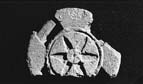
Object type: Cross-head
Measurements: H. 37 cm (14.6 in); W. 28 cm (11 in); D. 10 cm (3.9 in)
Stone type: [Ancaster Freestone, Upper Lincolnshire Limestone, Inferior Oolite Group]
Plate numbers in printed volume: 466–7
Corpus volume reference: Vol 5 p. Vol 5 p. 326–7
(There may be more views or larger images available for this item. Click on the thumbnail image to view.)
Loose in north aisle
None. Perhaps discovered during the restorations of 1852 (Pevsner and Harris 1964, 596) or 1879 (Cox 1924, 218)
Good. The stone is somewhat weathered.
An almost complete ringed cross-head from a standing shaft decorated in low relief. The lower cross-arm and the junction with the shaft below are missing. The cross-head itself is of type E10, with short blunt arms emerging from a large central disc and joined by a type (a) ring. The arms are undecorated. The ring is skilfully cut and has chamfered arrises, leaving a void between it and the disc. The central disc is decorated in low relief on both faces.
A (broad): Within the disc a patera of six petals set around a small central boss.
B and D (narrow): Undecorated
C (broad): The disc has a dished profile, leaving a circular boss in the centre.
Appendix G item (the continuing tradition).
This fragment is likely to have come from a small memorial cross which, although left exposed for a time, was not outside for a great period compared, for example, with the Elloe Stone. The overall design clearly mimics the late Anglo-Saxon monumental cross tradition, but the decoration and the cross-head type are unequivocally post-Conquest in date. The form of the circular patera on face A connects this cross-head with the late shaft at Aunsby (six miles east, see fig. 23), which is decorated in a very similar fashion (Ills. 434, 436). The similarities in decoration and stone type between the two monuments probably suggest a common production centre and certainly indicates a similar early or mid twelfth-century date. Similar late monuments are found quite widely nationally, and the examples at Whitehaven and Cumwhitton, Cumberland, and Woodhorn, Northumberland, have been discussed in the context of their Anglo-Saxon predecessors (Bailey and Cramp 1988, 166, 170; Cramp 1984, 249–50).
Unpublished
