Select a site alphabetically from the choices shown in the box below. Alternatively, browse sculptural examples using the Forward/Back buttons.
Chapters for this volume, along with copies of original in-text images, are available here.


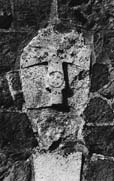
Object type: Grave-marker(?)
Measurements: H. c. 50 cm (19.75 in) W. c. 25 > 15 cm (9.75 > 6 in) D. Built in
Stone type: Pale greyish yellow fine-grained limestone with scattered shell fragments. Cathedral Beds, Lower Lincolnshire Limestone of Lincoln vicinity, Inferior Oolite Group
Plate numbers in printed volume: Ill. 283
Corpus volume reference: Vol 5 p. 223
(There may be more views or larger images available for this item. Click on the thumbnail image to view.)
A small round-headed or domed monument, tapering slightly from head to foot and decorated in low relief on its only visible face.
A (broad): This is carved with a cross of type B6 with equal wedge-shaped arms, set on a short stem: the arms extend to the edge of the stone. There is an incised circle at the centre of the cross and another beneath on the lower arm. The surface does not survive on the other three arms, which may have been similarly ornamented. The lower part of the stone appears damaged, truncating the stem, but this may have been the rough hewn foot of a grave-marker that was meant to be earthfast.
Categorisation of this piece has caused a diversity of view. For Butler (1961, 26; 1963–4, 113 fn. 1; 1964, 115) it was a grave-slab or 'coffin lid', reused in its present location. In addition to his comparison of its decoration with the cover from Hooton Roberts, Yorkshire WR, the graveyard of St Mark's at Lincoln now offers analogies of monument form in its series of small flat covers with domed heads (Stocker 1986a, 58) and generally of post-Conquest date. This sits well with Butler's placing it in the post-Conquest overlap period and perhaps in the later eleventh century. By contrast, for Pevsner, Taylor and Coatsworth the stone's deliberate positioning above the south doorway's keystone and echoing its wedge shape makes it an in situ architectural feature. Taylor's factually erroneous description of it as 'rudely carved with a small crucifixion which is now much weathered' (Taylor and Taylor 1965, 403; id. 1966, 51; Taylor 1978, 1056) was not accepted by Coatsworth, who saw 'no trace of there ever having been a figure on the cross, or any accompanying symbols or figures' (1979, 70).A third possibility is that this is a small upright grave-marker, later reused in an iconic manner. In its form it bears comparison to such small dome-headed markers in north-east England as Hexham 14 (Cramp 1984, pl. 179, 954), Bolam 1 (ibid., pl. 233, 1319–21), or Newcastle 1 (ibid., pls. 248, 1371 and 249, 1376). Its decoration is exactly that of Darlington 5 (ibid., pl. 149, 784–5) with its incised circles at the centre and on each arm of a B6 cross. A jet pendant cross with equal-sized expanding arms decorated in the same way with ring-and-dot from the Coppergate excavations in York comes from an eleventh- or twelfth-century context (MacGregor 1978, 41, fig. 23.3). The local analogies for a stemmed cross of this type, as at Nettleton 1 (Ill. 418) or Lincoln Cathedral 3 (Ill. 404), point to a later eleventh- or twelfth-century date.
The date of this piece and assessment of whether it is in situ or reused inter-relates with the assessment of the architectural pieces, Lusby 2–5 (below). The doorway has commonly been accepted as a pre-Conquest architectural feature (Brown 1925, 391, 469; Taylor and Taylor 1965, 402–4; Taylor 1978, 800, 833, 1028), but Cox (1924, 221) and Pevsner (Pevsner and Harris 1964, 308) have both thought it Norman.
