Select a site alphabetically from the choices shown in the box below. Alternatively, browse sculptural examples using the Forward/Back buttons.
Chapters for this volume, along with copies of original in-text images, are available here.


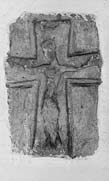
Object type: Crucifixion panel
Measurements: H. 35 cm (13.75 in) W. 22 > 21 cm (8.75 > 8.25 in) D. Built in
Stone type: Coated with greyish limewash, but appears to consist of close-packed ooliths of 0.3 to 0.5mm diameter. ?Ancaster Freestone, Upper Lincolnshire Limestone, Inferior Oolite Group
Plate numbers in printed volume: Ills. 285–6
Corpus volume reference: Vol 5 p. 230-232
(There may be more views or larger images available for this item. Click on the thumbnail image to view.)
A (broad): Small rectangular panel decorated with a Crucifixion, with no border or edge moulding. It is not possible to tell in its present setting whether it is complete in its surviving form or was formerly part of a larger monument. All four arms of the cross expand slightly (i.e. it is of type B6): it stands slightly proud of a reserved undecorated background and is outlined by a deep U-shaped groove that accentuates the cross further. The figure of Christ hangs from his hands, with arms bent at the elbows, head distinctly on one side and the body inclined the opposite way: the legs nevertheless are straight, the feet hanging straight down separately with toes individually defined, perhaps resting on a slightly raised sloping block or suppedaneum. The figure appears to wear a loin-cloth. No facial features are distinguishable because the head has been defaced. There are no decorative motifs or supporting figures. Though there is some damage to the upper arm of the cross, it is clear that there has been no Manus Dei.
This Crucifixion has commonly been taken to be a pre-Conquest piece or at least a piece in the pre-Conquest tradition (Taylor and Taylor 1965, 414; id. 1966, 13; Taylor 1978, 1056; Coatsworth 1988, 190–1). Dr Coatsworth's assessment, reflecting that view, was: 'difficult to date ... more precisely than tenth to twelfth century – but it could be tenth century' (Coatsworth 1988, 172–3). Bailey's inclusion of it in his discussion of the likely function of the Penrith plaque, for which he prefers a tenth- to a twelfth-century date, as a devotional wall plaque, also implicitly assumes a pre-Conquest date for the Marton 6 Crucifixion (Bailey 1986, 14; Bailey and Cramp 1988, 140–2). Yet the piece was not included in either of Davies's catalogues of Anglo-Saxon stones from the county (1914–15; 1926), nor in Butler's up-dating (1963–4). This contrast results in part simply from the lack of subsidiary and stylistic detail of the sculpture; but partly, too, because the piece is a curious combination of pre-Conquest and later features. The cross itself is a simple Corpus form (Cramp 1991, fig. 2), though locally best paralleled in incised or shallow relief variants on a range of plain grave-covers and related monuments all probably of eleventh- or early twelfth-century date (including Langton by Wragby 1 and 2, Carlby 2–4, Castle Bytham 1, Lincoln Cathedral 3, Lincoln St Mark 14 and 20, and Marton 4). Most locally relevant is the fragment with an incised cross of this type built into the rerearch jamb of the splayed opening of the first-floor keyhole window of the tower at Marton (no. 5; Ill. 300), since this secondary use is likely to indicate an eleventh-century date. The arrangement of the lower body and feet is a crude version of that found, for example, on Romsey II, Hampshire (Coatsworth 1988, pl. Ib), Muchelney, Somerset (ibid., pl. IVb) and Wormington, Gloucestershire (ibid., pl. Vc). The absence of crossed and nailed feet certainly guarantees a pre-thirteenth-century date. The sagging upper body and bent arms can be likened to accepted pre-Conquest sculptures, as at Breamore and Headbourne Worthy, Hampshire, and Great Glen, Leicestershire (Coatsworth 1979; 1988), in the first instance with an exaggeratedly curvilinear upper body line. But the type becomes more common at a later date. In the end, though a late pre-Conquest date for this panel is possible, it is difficult to prove. There is good evidence in rural Lincolnshire, particularly in the Crucifixion on the shaft at Minting (Ill. 460), for the persistence of simple early-looking Crucifixion formulae and thereby an analogous combination of early and late features. At Minting the supporting decoration makes it certain that this shaft is of later twelfth-century rather than earlier date. Here too at Marton a date towards the end rather than the beginning of Dr Coatsworth's suggested range is most likely. The strongest argument may be the complete absence of any supporting figures or other detailing, and in particular the omission of a Manus Dei, which is such a constant feature of pre-Conquest sculptural Crucifixions, including the local eleventh-century example on Harmston 1 (Ill. 199).
On this assessment the Marton panel can be viewed as analogous in content and date (though not in style) to pieces such as the second Crucifixion panel at Daglingworth, Gloucestershire (Coatsworth 1988, 179, 193), or the small roods at New Alresford, Hampshire, inserted into a Norman tower (Green and Green 1951, 40–1, pl. XII). In function, it might have served as a 'station', most commonly documented as illustrating the Nativity, the Passion, the Resurrection or the Ascension and taking the form of sculptured panels that might form the focus of liturgy (Parsons 1989, 8–9).
