Select a site alphabetically from the choices shown in the box below. Alternatively, browse sculptural examples using the Forward/Back buttons.
Chapters for this volume, along with copies of original in-text images, are available here.


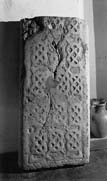
Object type: Incomplete grave-cover [1]
Measurements: L. 120 cm (47.25 in) W. 56 > c. 54 cm (22 > 21.25 in) D. 18 cm (7 in)
Stone type: Grey oolitic limestone, with closely-set ooliths 0.5mm in diameter in a calcite matrix, scattered small ostreids, and two large (c. 5cm diameter) Pecten-like shells; 'honeycomb' surface texture in places where the stone is worn. Upper Lincolnshire Limestone, Inferior Oolite Group
Plate numbers in printed volume: Fig. 14; Ills. 81–2
Corpus volume reference: Vol 5 p. 125-126
(There may be more views or larger images available for this item. Click on the thumbnail image to view.)
Only the south stop (a) preserves details that are capable of description. Its fellow (b) may have been similar, perhaps identical. The stop comprises a full-face human head. The eyes are simply gouged-out hollows, the nose is long and somewhat flattened, the lips appear to have a lop-sided or even pouting expression, but this may be caused by an original drooping moustache, now very rounded by weathering. It is possible that a line across the forehead marks a fringe or head-dress.
This is one of the interlace covers of Lindsey type discussed in Chapter V. It is the most complete example of sub-group (b), distinguished by its single cable border (Table 6). Five rows of figure-of-eight remain, as with the sub-group (a) example at Miningsby (Ill. 301) with a similar reuse. If, as Northorpe 1 suggests (Ill. 308), what is lacking is only a completion of the pattern and a border, then the complete cover had a length of about 135–40 cm (53–55 in).
