Select a site alphabetically from the choices shown in the box below. Alternatively, browse sculptural examples using the Forward/Back buttons.
Chapters for this volume, along with copies of original in-text images, are available here.


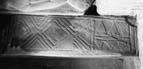
Object type: Grave-cover [1]
Measurements: L. 136 cm (53.5 in) W. 43 > 41 cm (17 > 16.1 in) D. 12 cm (4.7 in)
Stone type: Very fine-grained micaceous sandstone with prominent bedding parallel to the top face. Light yellow brown to olive yellow (2.5Y 6/4–6/6). Upper Carboniferous (Namurian) flagstone, from the nearly river Tees valley
Plate numbers in printed volume: Ill. 1140
Corpus volume reference: Vol 6 p. 279
(There may be more views or larger images available for this item. Click on the thumbnail image to view.)
The upper face is surrounded by a double incised moulding and divided into two unequal panels.
The larger is covered with intersecting lozenges, one complete and six bisected. In the smaller panel are six relief triangles attached to a central 'bar'.Appendix A item (stones dating from Saxo-Norman overlap period or of uncertain date).
Although recumbent grave-covers with lightly incised lozenges and other forms of fine hatching are known on the continent from the Merovingian period, slabs which incorporate such decoration in England can be assigned to the eleventh century or later. Everson and Stocker have compared this piece with Whaplode 2 in Lincolnshire (1999, 271, fig. 30, ill. 386), but more closely similar are Bolam 2, Northumberland (Cramp 1984, 238, pl. 235, 1333) and Gainford 33, co. Durham (ibid., 153, pl. 152, 796), both of which have been dated to the late eleventh century. The relief triangles are akin to Romanesque 'dog tooth' ornament.
