Select a site alphabetically from the choices shown in the box below. Alternatively, browse sculptural examples using the Forward/Back buttons.
Chapters for this volume, along with copies of original in-text images, are available here.


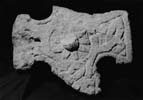
Object type: Cross-head [1]
Measurements: H. 37 cm (14.5 in) W. 50 cm (19.7 in) D. 15 cm (6 in)
Stone type: Coarse-grained micaceous Millstone Grit; brown (7.5YR 5/2). Certainly from the Upper Carboniferous (Namurian), probably from a North Pennine source
Plate numbers in printed volume: Ills. 299–302
Corpus volume reference: Vol 6 p. 119
(There may be more views or larger images available for this item. Click on the thumbnail image to view.)
The upper arm and most of the lower arm of this cross-head are lost, but this appears to be a local variant of type 11. Only the broad faces are decorated.
A (broad) : In the centre of the head is a prominent boss surrounded by a sunburst or rosette with pointed flat petals. This is enclosed in a broad flat strand which branches off to develop into interlace in the arms. Only the pattern on the right hand arm is clear where two strands develop into a pattern E knot.
C (broad) : The pattern is essentially the same but the central boss is broader and the strands which develop into the pattern E knots in the arms are stretched into a diamond shape around the sunburst.
The shape of the head with its short arms, and the broad flat strands of simple interlace place this late in the series, but the central motif is striking. Central bosses are one of the commonest features of cross-heads and it is noteworthy that they are more prominent through time, reaching considerable depth in later monuments such as those from Whalley in Lancashire (Collingwood 1927a, fig. 132). Rosette centres are also of frequent occurrence, but this type of motif, with rays rather than petals, seems to be unparalleled.
