Select a site alphabetically from the choices shown in the box below. Alternatively, browse sculptural examples using the Forward/Back buttons.
Chapters for this volume, along with copies of original in-text images, are available here.


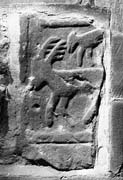
Object type: Shaft fragment(?) [1]
Measurements: H. 37 cm (14.6 in) W. 20.6 cm (8.1 in) D. Built in
Stone type: As no. 2
Plate numbers in printed volume: Ill. 431
Corpus volume reference: Vol 6 p. 146-147
(There may be more views or larger images available for this item. Click on the thumbnail image to view.)
On the left is a broad modelled edge moulding. Between two thinner transverse mouldings is a profile stag facing left with branched antlers and straight back. One of the hind legs is lost. The stag has an incised elliptical eye and a mouth slit. The torso is damaged. Over its back is the front half of a springing hound, its forepaws on the stag. It has a small pricked ear. Below the lower transverse moulding the plain surface is broken.
The image is the classic 'hart and hound' motif which occurs across the Viking colonies of Yorkshire and Cumbria: for example, Forcett 1 (Ill. 251), Melsonby 3 (Ill. 651), Ellerburn 5 (Lang 1991, 128, ill. 432), Dacre 2 (Ill. 1193; Bailey and Cramp 1988, 91–2, ill. 245), and beyond to Lancaster and the Isle of Man (Collingwood 1927a, 150–2, figs. 170–2; Kermode 1907, 55, 64). Whilst many would argue for the motif's origins lying in the hunt scenes on Celtic monuments, Bailey has suggested a Christian interpretation (Bailey 1977, 68–9, 70–1). The Yorkshire examples are not associated with known monastic sites, and in this secular milieu it is prudent to attribute them to the Hiberno-Norse settlements of the tenth century. Kirklevington's many Irish connections strengthen this opinion.
