Volume 6: Northern Yorkshire
Select a site alphabetically from the choices shown in the box below. Alternatively, browse sculptural examples using the Forward/Back buttons.
Chapters for this volume, along with copies of original in-text images, are available here.
Current Display: Kirklevington 23, Yorkshire North Riding


Overview
Object type: Fragment [1]
Measurements: H. 25 cm (9.8 in) W. 34 cm (13.4 in) D. Built in
Stone type: [Sandstone]
Plate numbers in printed volume: Ill. 460
Corpus volume reference: Vol 6 p. 151-152
(There may be more views or larger images available for this item. Click on the thumbnail image to view.)
Present Location
Built into the exterior east wall of the chancel, between the southern and central lancet windows
Evidence for Discovery
See no. 1. The chancel is thirteenth-century, but the upper part of the east wall was rebuilt in 1883 (Page, W. 1923, 262). J.L. identified Collingwood's (2), 'a fragment of interlacing built into the east end, outside' (1907, 351), with no. 9 above, but Collingwood, who only noted one piece in the east wall, may have been referring to this fragment. First specifically recorded during Cleveland County Archaeology's Churches Survey in 1981 (Tees Archaeology S.M.R., 0243)
Church Dedication
St Martin
Present Condition
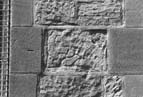
Worn; the upper right half of the visible face is scabbled.
Description
The remains of plain edge mouldings survive below and to the left. Within the panel is part of a ring-knot with return loops in flat strand.
Discussion
Probably part of a cross-shaft: the interlacing is similar to that on Kirklevington 5A (Ill. 416).
D.C.
Date
First half of tenth century
References
Unpublished(?)
Endnotes
[1] The following are general references to the Kirklevington stones: Browne 1880–4, cx, cxii; Young 1882, 458; Allen and Browne 1885, 352; Frank 1888, 44; Bulmer 1890, 162; Hodges 1894, 195; (—) 1896–1905a, viii; Lofthouse 1896–8, 16; (—) 1899–1900b, 250; Morris, J. 1904, 228–9, 420; Collingwood 1908, 120; Page, W. 1923, 262; Morris, J. 1931, 229, 417; Elgee and Elgee 1933, 217, 248; Mee 1941, 136; Pevsner 1966, 221; Morris, C. 1976a, 143–4; Brown, M. 1979, 44; Horton 1979, 195; Bailey 1980, 252, 255, 265; Cramp 1984, 30; Lang 1991, 42, 214; Daniels 1995, 81; Stocker 2000, 200–3.