Select a site alphabetically from the choices shown in the box below. Alternatively, browse sculptural examples using the Forward/Back buttons.
Chapters for this volume, along with copies of original in-text images, are available here.


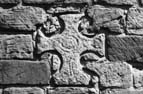
Object type: Cross-head
Measurements: H. c. 53 cm (20.8 in) W. c. 50 cm (19.7 in) D. Built in
Stone type: Medium- to coarse-grained deltaic sandstone with sub-rounded grains; weathered to very pale brown colour (10YR 8/4). Possibly Upper Carboniferous deltaic sandstone (cf. Kirklevington 2, p. 142)
Plate numbers in printed volume: Ill. 462
Corpus volume reference: Vol 6 p. 152-153
(There may be more views or larger images available for this item. Click on the thumbnail image to view.)
A free-armed cross of type B9 with widely curving arm-pits and shallow squared ends to the arm-tips. The edge moulding is modelled but extremely worn for the most part. In the centre is a very shallow, perhaps damaged, boss surrounded by a modelled ring. The upper and lateral limbs are extremely worn; the lower limb has spalled but on the right may be faint traces of a simple two-cord twist. The base of the lower arm is chamfered, narrowing sharply inwards to what remains of the shaft.
This well-proportioned cross-head is Anglian with a rare form of neck to accommodate a narrower shaft. There are echoes of some of the Whitby Plain Cross series in the wide arm-pits and shallow squaring of the tips (Chap. VI, p. 39). The encircling ring around the boss has parallels in a series of cross-heads from York (Lang 1991, ills. 235, 354, 373, 385), though this piece differs in having a livery of twist as decoration for the arms, unlike the plain heads from York.
Leake stands on one of the main thoroughfares linking Durham and York, and was for centuries part of the diocese of Durham. Perhaps, like Crayke, it was a staging post for the Community of St Cuthbert in the pre-Conquest period (cf. Cambridge 1989, fig. 33).
