Select a site alphabetically from the choices shown in the box below. Alternatively, browse sculptural examples using the Forward/Back buttons.
Chapters for this volume, along with copies of original in-text images, are available here.


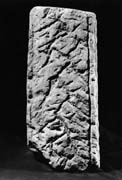
Object type: Part of shaft
Measurements: H. 62.7 cm (24.7 in) W. 29.5 > 23.8 cm (11.6 > 9.4 in) D. 17.5 > 15 cm (32.4 > 5.9 in)
Stone type: Medium-grained, well sorted, deltaic sandstone. Very pale brown (10YR 7/3). Stone provenance as no. 2
Plate numbers in printed volume: Ills. 475–8
Corpus volume reference: Vol 6 p. 154-155
(There may be more views or larger images available for this item. Click on the thumbnail image to view.)
A (broad) : The damaged edge moulding is cabled and flanks a single panel containing very debased interlace in a broad flat strand. It is basically a three-cord plait but the pattern degenerates at the top.
B (narrow) : The edge moulding is cabled and frames the top of a single panel filled with bold fret pattern (step 1).
C (broad) : The edge moulding is cabled and slightly slimmer than on face A. Within the single panel is debased and confused interlace with no inherent logic, formed by hacked diagonals.
D (narrow) : Much damaged (since Collingwood?), it has traces of step 1 fret near the base.
An amateurish carving, it has less detail to show than when Collingwood drew it. It is surprising that such clumsy panels should be framed by cabled edge mouldings, and it is possibly a reuse of an existing stone.
