Select a site alphabetically from the choices shown in the box below. Alternatively, browse sculptural examples using the Forward/Back buttons.
Chapters for this volume, along with copies of original in-text images, are available here.


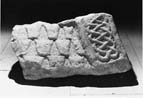
Object type: Hogback fragment [1]
Measurements: L. 55.9 cm (22 in) W. 27.9 cm (11 in) H. 29.2 > 22.9 cm (11.5 > 9 in)
Stone type: As Lythe 9 (St Oswald), however this fragment has been partly burnt to a reddish brown colour (5YR 6/6).
Plate numbers in printed volume: Ills. 536–8
Corpus volume reference: Vol 6 p. 159-160
(There may be more views or larger images available for this item. Click on the thumbnail image to view.)
The top is defaced but the ridge was eccentrically placed.
A (long) : Below the ridge position are three rows of type 2b tegulae. At the right-hand end, in the usual position for an end-beast, is a panel framed in a roll moulding containing loosely woven closed circuit interlace: five stages of four-cord plait. The strand is modelled.
B (end) : The end of the monument is plain and slightly inclined, like a hipped roof.
C (long) : As face A.
This is a type k hogback, the enriched shrine variety (Lang 1984a, 101), which was popular in this area: Lythe has seven and Easington one (no. 8. p. 106). The absence of end-beasts is made up for by rectangular panels of decoration, here interlace, which echo metalwork usage of applied panels of filigree (Chap. IV, p. 23). The plain end may have been concealed by an end-stone grave-marker, one of the series Lythe 9–16, whose angular cross forms echo the roof pitch of this type of hogback (above, p. 157, Ills. 498–531; see Chap. VI, p. 49). This piece was carefully planned and cut with assurance.
