Select a site alphabetically from the choices shown in the box below. Alternatively, browse sculptural examples using the Forward/Back buttons.
Chapters for this volume, along with copies of original in-text images, are available here.


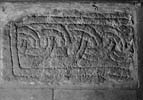
Object type: Part of shaft or slab [1]
Measurements: L. 78.7 cm (31 in) W. 43.2 cm (17 in) D. Built in
Stone type: Medium-grained sandstone with sub-angular grains. Very pale brown (10YR 7/6). Sandstone of local origin, Namurian, Upper Carboniferous
Plate numbers in printed volume: Ill. 649
Corpus volume reference: Vol 6 p. 178
(There may be more views or larger images available for this item. Click on the thumbnail image to view.)
A broad, grooved, double edge moulding frames the sides and end of a long panel. The plain inner moulding is slimmer than the outer. Within the panel is a run of bungled median-incised interlace in hacked and picked work. The pattern attempts to be a three-cord plait. At the end of the panel the strands are chopped off at an arbitrary point rather than being resolved in a terminal (contra Collingwood 1907). Some elements tend to be stopped-plait.
This is a very crude, unplanned work. It is the top of a shaft, judging from the panel termination, although Pevsner (who saw the stone lying loose) thought it a slab. Stopped-plait interlace is a feature of Viking-age carving in Cumbria and south-west Scotland (Bailey and Cramp 1988, 35, fig. 6b, ill. 688).
