Select a site alphabetically from the choices shown in the box below. Alternatively, browse sculptural examples using the Forward/Back buttons.
Chapters for this volume, along with copies of original in-text images, are available here.


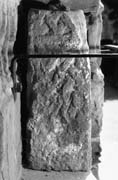
Object type: Shaft fragment [1]
Measurements: H. 60.4 cm (23.8 in) W. 21.7 > 20 cm (8.5 > 7.9 in) D. 23.2 > 21.5 cm (9.1 > 8.5 in)
Stone type: Medium-grained deltaic sandstone with some feldspar grains present; well sorted with sub-angular to sub-rounded grains. Brownish yellow (10YR 6/6). Stone provenance as Osmotherley 1 (St Peter)
Plate numbers in printed volume: Ills. 721–2
Corpus volume reference: Vol 6 p. 190-191
(There may be more views or larger images available for this item. Click on the thumbnail image to view.)
A (broad) : Largely defaced, but faint traces remain of a plain strap, above which is a transverse border, and above that an interlace terminal. The strands are 2.5 cm (1 in) wide.
B (narrow) : The broad edge moulding is plain. The base of the face is undecorated for 19.5 cm (7.7 in). A single panel contains a simplified ring-chain pattern with pellet fillers and thin strand.
C (broad) : Defaced.
D (narrow) : Not visible.
Ring-chains are typical of the Scandinavian contribution to tenth-century carvings in Yorkshire. This one is simplified into free rings interlocked on an axial stem (Cramp 1991, xlv, fig. 26, C v), a form which does not occur in Scandinavia or the Isle of Man where the Borre-style origins are more discernible. But compare Kirklevington 9 (Ill. 426).
