Select a site alphabetically from the choices shown in the box below. Alternatively, browse sculptural examples using the Forward/Back buttons.
Chapters for this volume, along with copies of original in-text images, are available here.


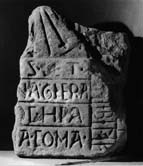
Object type: Part of sundial
Measurements: H. 38.5 cm (15.2 in) W. 30 cm (11.8 in) D. 16 > 15 cm (6.3 > 5.9 in)
Stone type: Medium-grained slightly feldspathic deltaic sandstone, with sub-rounded grains in a well sorted fabric. Brownish yellow (10YR 6/6). Deltaic sandstone from the Saltwick Formation (Aalenian, Middle Jurassic). This stone caps the Cleveland Hills to the east, and numerous quarries have supplied both building and artefact stone.
Plate numbers in printed volume: Ill. 744
Corpus volume reference: Vol 6 p. 195-197
(There may be more views or larger images available for this item. Click on the thumbnail image to view.)
The dial is recessed about 2 cm below the inscribed areas. The surviving lines on the dial allow it to be reconstructed as having divided the period of daylight into twelve divisions in accordance with Roman and ecclesiastical practice. The division into four or eight is more common on surviving pre-Conquest sundials, but the dials on the Bewcastle Cross and on the church at Bishopstone in Sussex also indicate twelve hours (Green 1928). The dial at Skelton marks the lines of the sixth and eighth hours with a cross, a pattern that can be seen in Yorkshire early in the twelfth century on the inscribed sundial at Weaverthorpe (ibid., 512–13).
Inscriptions The right-hand section of four horizontal lines of incised Roman lettering occupies the space below the dial. This is flanked on the right by part of a line of incised Norse runes that runs vertically down the stone. The remnants of two 'vertical' strokes immediately to the right, that is 'above' this line, are probably an indication of a further line of runes. The inscriptions in both scripts were boldly cut and the lines of characters in both were set between deeply incised framing lines. Similarly, both used a mid-line point to mark word-division. The Roman characters and the runes were about 4 cm and 5 cm in height respectively.
Inscription in Roman lettering The first part of each line of text has been lost. A symmetrical reconstruction would imply that what remains is a little over half of each line (Fallow 1892, fig. on p. 66). A somewhat broader strip of uncarved stone runs below the fourth line of Roman lettering and suggests that this was the last line, although this is not certain. In spite of some damage, most of the remaining letters can be read with certainty:
— [E]S : [LE]T :
&mdash [N]AG[.]ERA
— [O]C : H[Ƿ]A
— A : COMA :
The following points should be noted about the transcription. The extreme ends of three horizontals can be seen at the beginning of line 1. These are probably part of E but Æ is also a possibility. The reading of the damaged character between the G and the E in line 2 is problematic. If the marks to the right of the vertical stem were deliberate, it was probably a K (giving — [N]AG[K]ERA). If, however, the marks were accidental, the letter was I (giving — [N]AG[I]ERA). There is no room for the R suggested by Fallow (1892). The mark between the tops of the A and the G in line 2 has been taken as a word-divider (Fallow 1892; Okasha 1971, 114). It is, however, set much higher in the line than the unambiguous word-dividing points and no space has been left between the two letters. It is either an accidental mark or was added as a second thought after the letters had been laid out or cut.
The language is probably Old Norse, or at least heavily influenced by Old Norse. The complete word COMA looks like Old Norse koma ('to come'; cf. Old English cuman). [O]C could represent Old Norse ok ('and'), which also seems to appear in the associated runic inscription (see below), and G[I]ERA could well be a form of Old Norse gera ('to make'). [LE]T might be either Old English lēt (as at Kirkdale) or Old Norse lét (as in many Scandinavian runic inscriptions). It means 'had (something done)', and on Scandinavian monuments it is often combined with gera in the formula 'X had [a memorial/gravestone/church] made'. The Skelton text could be of this type, and if so it could even be tentatively suggested that — [N]A before G[.]ERA might represent the end of the Old Norse demonstrative pronoun (masculine, accusative) þenna. Some such sequence as X lét stein þenna gera ('X had this stone made') would be good Old Norse, and could be paralleled in many broadly contemporary runic inscriptions in Scandinavia.
At first sight, the sequence H[Ƿ]A seems more problematic for an Old Norse reading. Okasha (1971, 114) thought the use of wynn strange in an Old Norse text, though this is not a real objection, since Old Norse v was a bilabial, equivalent to w, in the Viking Age (Feilitzen 1937, 75; so also Fell quoted by Holman 1996, 80). If the Skelton inscription offers evidence of Roman script learned by an Old Norse speaker in northern England, wynn would be the natural choice of character to represent the Old Norse sound. Another apparent problem is that *hva or *hvá does not appear in classical Old Norse paradigms, whereas Old English hwa ('who', 'someone', 'anyone') is common. It is, however, likely that an equivalent Old Norse hvá ('who') was in early use (cf. Noreen 1923, § 474, 1 Anm. 1; Jacobsen and Moltke 1942, col. 699, s.v. hwa), and this could be represented here. Alternatively, of course, the word might have continued onto the next line, in which case there are numerous Old Norse possibilities (hvar 'where', hvat 'what', hvargi 'everywhere', etc.).
It appears possible, therefore, that the language of the inscription was wholly Old Norse. Yet it is clearly in too fragmentary a state for this to be certain, and an admixture of Old English cannot be ruled out. [1]
The letters are plain unserifed capitals with some angular forms. A has the most individual form, the capital with a short head-bar projecting to the left and a cross-bar sloping down to the left. C is a narrow version of the angular capital. E, H, T and the probable L are the normal capital forms. G is a rounded version like an open '6', in which the short right-hand stroke curls round into the interior of the letter. M is a version of the capital with vertical sides and a central 'V' that only descends about half way down the letter. O is pointed at the top and bottom. R is the capital with a closed bowl and the right leg joining the bowl well away from the stem. S is the angular 'reversed-Z' form of the capital. The rune wynn with a rounded bowl is used for 'w'. These capitals fit into the context of late Anglo-Saxon inscriptions. The inscriptions accompanying the Kirkdale sundial of c. 1060 have similar serifless capitals and can match the forms of C, E, G, H, M, T and wynn (Okasha 1971, pl. 64; Lang 1991, 164–6, ills. 568–73). It also has examples of A with a diagonal cross-bar but, in this case, sloping down to the right. It uses a different form of angular S, but 'reversed-Z' S is common in both early and late Anglo-Saxon inscriptions (S2 in Okasha 1964–8, table 1a). Skelton further resembles Kirkdale in its use both of single mid-line points to divide words and of deeply incised framing lines.
Inscription in Norse runes The partly legible line of runes is heavily worn at the beginning and may be broken away at the end. The section which survives reads:
— [. . ie]bel•o[k]•
Before i there are traces of at least two verticals, the second with an arm to its left, suggesting a. Early drawings (Fallow 1892, 66; Stephens 1901, 50) tend slightly to embellish this part of the inscription, but the photograph printed by Fallow (1892, pl. III) suggests that the condition of the stone here has not significantly deteriorated.
The forms of e, o and k indicate that the runes are Scandinavian rather than Anglo-Saxon. The first part of the text is obscure; ok is presumably Old Norse ok ('and'). The e-rune, comprising a stave with a dot in the middle, suggests the inscription is no earlier than c. 1000 (Jacobsen and Moltke 1942, cols. 999–1003; Parsons 1998, 444–5). The spelling of ok is also a relatively late feature (cf. frequent runic auk in Viking-age inscriptions), but Holman's suggestion (1996, 80) that it indicates a post-Conquest date appears unfounded; the absolute chronology of the relevant linguistic and orthographic changes remains unclear (Kreuzer 1995).
The Skelton fragment can be associated with the later Anglo-Saxon fashion for placing inscribed sundials on stone churches (Lang 1991, 46–7, 123–4, 133–5, 163–6, 195; Tweddle et al. 1995, 109, 124–5, 147–9; Everson and Stocker 1999, 258–9). There is a notable group in Yorkshire: Aldbrough, Great Edstone, Kirkdale and Old Byland, all probably of the eleventh century, and Weaverthorpe of the beginning of the twelfth (Lang 1991, 46–7, 123–4, 133–5, 163–6, 195; Green 1928, 512–13). The inscriptions on these sundials are concerned with such matters as recording the names of patrons and makers and with the nature and purpose of sundials. The Old English vernacular was employed at Aldbrough, Great Edstone and Kirkdale in Yorkshire, at Stow in Lincolnshire, and at Orpington in Kent. The probable lét (or lēt) and a possible form of Old Norse gera in the inscription in Roman lettering, verbs respectively of patronage and making, suggest similar concerns at Skelton.
Although Roman script and Anglo-Saxon runes are found together on a number of monuments, Skelton is the only English stone to combine Roman script with Norse runes. The designer contrasted the two scripts by setting the Roman-letter inscription in horizontal lines and the runic inscription vertically (the one legible line running downwards). Vertically set inscriptions were the norm on stone monuments inscribed with Scandinavian runes (see Moltke 1985 for many examples). Two vertically set lines of Norse runes separated by an incised line can be paralleled in England on the slab found in St Paul's churchyard in London (Tweddle et al. 1995, 226–7, ills. 350–2). If the language was wholly or principally Old Norse, as suggested above, it would be the only example of an Old Norse Roman-script inscription known from England. [2]
The context of inscribed sundials in late Anglo-Saxon Yorkshire, the general kinship with the inscriptions of c. 1060 at Kirkdale in lettering, word-division and deeply incised framing lines, and the presence of the e-rune all suggest that the Skelton dial was made some time in the eleventh century.
[1] Of previous commentators, R. I. Page (1995, 189) drew attention to the possible Old Norse elements giera for gera and coma for koma, but did not comment further; while Okasha (1971, 114) felt that the text was 'probably in ON ... alternatively it may be in mixed OE and ON.' (The three paragraphs on the language of the inscription were written by David Parsons.)
[2] The first and last sentences of this paragraph were contributed by David Parsons.
