Select a site alphabetically from the choices shown in the box below. Alternatively, browse sculptural examples using the Forward/Back buttons.
Chapters for this volume, along with copies of original in-text images, are available here.


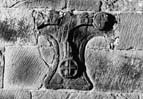
Object type: Part of cross-head
Measurements: H. c. 43 cm (17 in) W. c. 43 cm (17 in) D. Built in
Stone type: AsStainton 1 (St Peter and St Paul), except that the stone is weathered to a brown (10YR 5/3) colour.
Plate numbers in printed volume: Ill. 748
Corpus volume reference: Vol 6 p. 200
(There may be more views or larger images available for this item. Click on the thumbnail image to view.)
One complete vertical and parts of two horizontal arms of a cross (type B9) survive, outlined by a fine roll moulding. In the centre is a lorgnette motif in high relief. In the upper arm the lorgnette contains a relief crosslet, and in the transverse arm an incised crosslet. The centre of the head has been cut away.
Collingwood'saw this as part of a slab but it is clearly part of the head of a free-armed cross, without the plate infill which he drew (1907, fig. b). The lorgnette type of head is common in this area (see Chap. VI, pp. 43–4), but the motif seems to have a long life in which its form is subject to several mutations. There is a close parallel with incised crosslets on a cross-head at Aberford in the West Riding (Collingwood 1915, 130); and the Redmire plant-scrolls (Appendix B, p. 292), which seem to be Romanesque, have incised crosslets in roundels instead of berry bunches. Crosslets in relief are less common, but occur as random motifs in very late work such as the shaft from Ecclesfield, also in the West Riding (Collingwood 1915, 172), which is surely post-Conquest. On the other hand this is a well carved piece and could belong to an earlier phase.
