Select a site alphabetically from the choices shown in the box below. Alternatively, browse sculptural examples using the Forward/Back buttons.
Chapters for this volume, along with copies of original in-text images, are available here.


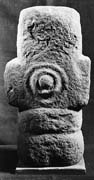
Object type: Cross-head, possibly finial
Measurements: H. 46.4 cm (18.3 in) W. 17 < 23.7 > 19.5 cm (6.7 < 9.3 > 7.7 in) D. 16.5 > 14 cm (6.5 > 5.5 in)
Stone type: Fine-grained, well sorted, micaceous sandstone, with the bedding parallel to the flat face with the boss. The colour of the rock is variable, from brown (10YR 5/3) to very pale brown (10YR 7/3). Of local origin, from the Namurian Yoredale cyclothem that outcrop in the Tees Valley.
Plate numbers in printed volume: Ills. 1164–7
Corpus volume reference: Vol 6 p. 286
(There may be more views or larger images available for this item. Click on the thumbnail image to view.)
A (broad) : The neck of the cross is sub-cylindrical, formed of two broad plain roll mouldings. The lateral arms are very short indeed, the upper limb straight-sided and plain. At the intersection of the cross is a domed boss within two concentric rings, cut in slanting planes.
B and D (narrow) : Plain apart from the roll mouldings at the neck.
C (broad) : As face A on the neck and arms, though damaged at the top. In the centre is a domed boss within a roll-moulded ring which erupts into a simple Latin cross (type A1) to fill the upper limb.
Appendix A item (stones dating from Saxo-Norman overlap period or of uncertain date).
The form of this cross is unique and it is probably a post-Conquest finial. However, the boss within rings, whilst a skeuomorph of rivet covers, has parallels in the pre-Conquest crosses from York: for example, The Mount 1 (Lang 1991, 110–11, ills. 354–6).
