Select a site alphabetically from the choices shown in the box below. Alternatively, browse sculptural examples using the Forward/Back buttons.
Chapters for this volume, along with copies of original in-text images, are available here.


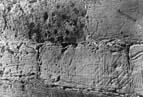
Object type: Alleged runic inscription
Measurements: (after Fallow 1911) L. 38 cm (15 in) W. c.12.7 cm (c.5 in) D. Built in
Stone type: Sandstone' (ibid.)
Plate numbers in printed volume: Ill. 1184
Corpus volume reference: Vol 6 p. 287
(There may be more views or larger images available for this item. Click on the thumbnail image to view.)
See the Discussion section below.
Appendix A item (stones dating from Saxo-Norman overlap period or of uncertain date).
Alleged inscription The history of the rune-inscribed stone(s) from Thornaby is obscure. Thirty years ago R. I. Page summarised the evidence for discovery then known to him (1971, 168; reprinted in Page, R. 1995, 183–4): in 1894 George Stephens noted an inscription, communicated to him by [T.] M. Fallow, which was 'Slightly scribbled in, below a small stone Sundial in the wall of the Church', and which 'In spite of many accidental-scratches, we can read: IT BISTR IS AN BI-UIK' (Stephens 1894, 15); thirteen years later W. G. Collingwood (1907, 402–3) published a drawing of an inscribed stone on which he read 'II BISTR III', noting however that 'there is hardly room for the whole [of Stephens's] inscription'. Page continued:
"Collingwood's accounts of the stone present a further problem. Fallow, whose description [1911, 238] is the most detailed, reported that the stone was 'near the ground at the east end of the south wall'. Collingwood'said it was 'under E. window outside', which sounds like a different place, unless Collingwood was misreading his notes [Colling-wood 1912, 127; cf. 'beneath the east window', Collingwood 1907, 402]. Could there have been two faintly marked stones, on one of which Collingwood identified runes as a consequence of reading Stephens's account of the other? "
Since writing this, Page has turned up evidence which tends to support his hypothesis. Fallow's letter informing Stephens of the find survives in Lund University Library, as does his photograph (Ill. 1184). Although the pictured stone is of roughly the same relative proportions as that drawn by Collingwood (Ill. 1185), the marks on it are not very similar, and there are clearly many more lines – whether man-made or accidental – on Fallow's stone than on Collingwood's drawing. Moreover, the sundial which Stephens and Fallow mention is quite clear on the photograph, whereas Collingwood could find no trace of it (1907, 402). It would appear that Collingwood was not misreading his notes, but rather that he was looking at a different stone.
If these observations are correct, one must conclude with Page that the similarity between Collingwood's reading (with which his drawing, showing [..]b[.]s[.r]—, is more or less compatible) and Stephens's published text, is suspicious, and that Collingwood may have been both searching and drawing with the eye of faith. Other explanations could be considered: a genuine inscription on the south wall might, for instance, have been partially copied onto a stone on the east wall. Yet it is questionable whether there ever was a genuine inscription that read anything like 'it bistr is an biuik', which Stephens translated 'This is the best at Bi-wik' (with Bi-wik an unidentified place-name). As Page remarked, 'Stephens's reading is convincing neither as Old Norse nor as a useful comment to cut on a stone' (1971, 168). Indeed, the new evidence from Lund throws further doubt on Stephens's whole account of the text. In his original letter, Fallow mentions only the photograph that we have: he did not apparently include a drawing or other material. If Stephens based his reading entirely on the surviving photograph, then it is a very bold attempt. The numerous vertical lines on the stone, perhaps too regular to be the effects of weathering, are crossed by many other lines, some of them clearly natural cracks, others possibly carved. Whichever way up the photograph is held, however, it is hard to identify any clear rune-forms.
