Select a site alphabetically from the choices shown in the box below. Alternatively, browse sculptural examples using the Forward/Back buttons.
Chapters for this volume, along with copies of original in-text images, are available here.


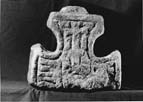
Object type: Cross-head [1]
Measurements: H. 31.8 cm (12.5 in) W. 33.6 cm (13.2 in) D. 18 > 15 cm (7 > 6 in)
Stone type: As Wath 1 (St Mary)
Plate numbers in printed volume: Ills. 853–7
Corpus volume reference: Vol 6 p. 219
(There may be more views or larger images available for this item. Click on the thumbnail image to view.)
The cross-head has a knob on the top arm which is type A10, the lateral arms are type B10. The faces are outlined by a heavy roll moulding.
A (broad) : In the upper arm is a small standing cross with wedge-shaped arms (type B1) which is set on a T-shaped base and an indistinct round feature in the centre of the cross. In the left arm are four incised horizontal lines forming four raised 'rods'. The centre and most of the right arm are obliterated although there are tips of what may be similar 'rods' at the top margin.
B (narrow) : The end of the horizontal arm has an incised saltire cross.
C (broad) : This face is almost obliterated, but possibly has a knot at the end of each arm linked by long strands around a central feature.
D (narrow) : As face B.
E (top) : In the centre of the upper arm terminal is a damaged boss or knob.
This piece is so closely similar to Finghall 5 (Ills. 245–9) that they must be the products of the same local group or even individual carver. In both the cross-head is enhanced by additional crosses on the broad face A and the ends of the arms, and both have the bar-like or finger-like features extending to the edges of the arms on face A.
Coatsworth considered that these were merely decorative features, and that 'the intention to represent Christ on the cross seems very doubtful' (Coatsworth 1979, II, 74). Nevertheless, given the other crude Crucifixion scenes on crosses from this area, for example Thornton Steward 1, 4 and 5, Thornton Watlass 1 and 2, or Sinnington 11 (Lang 1991, ill. 814), where the extended fingers fill the end of the arm, it is perhaps better not to rule out the possibility of this being intended to invoke the crucified Christ, with the prominent circle on face A at Finghall also to be related to the Host on the two cross-heads from Thornton Watlass (see Chapter V).
