Select a site alphabetically from the choices shown in the box below. Alternatively, browse sculptural examples using the Forward/Back buttons.
Chapters for this volume, along with copies of original in-text images, are available here.


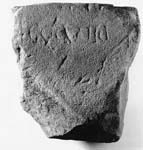
Object type: Upper part of stele [1]
Measurements: H. 22.2 cm (8.8 in) W. 19.2 cm (7.1 in) D. 9.8 cm (3.8 in)
Stone type: Medium-grained deltaic sandstone containing muscovite mica and feldspar; the fabric is well sorted and the grains sub-angular. Pale brown (10YR 6/3). Stone provenance as Whitby 1 (abbey, St Peter and St Hilda)
Plate numbers in printed volume: Ills. 1031–6
Corpus volume reference: Vol 6 p. 253-255
(There may be more views or larger images available for this item. Click on the thumbnail image to view.)
The surviving faces of this small slab-like monument are carefully dressed. The lower parts have been cut away.
A (broad) : Extremely worn. Traces of plain edge moulding at the top.
Inscription A short one-line incised inscription occupies a position near the top of one of the two broad faces of this fragment. The letters, which are about 2 cm in height, have suffered considerably from weathering and other damage. Four of the letters can be read with reasonable confidence:
D is the most probable reading of the damaged last letter, although its gently leaning stem make it possible that the intended letter was an uncial A of the sort seen in Whitby 21 (Ill. 970). There are traces of two letters between the recognizable letters. These may have been an M and a V, as suggested by Radford, although his reconstruction drawing is over-confident (Peers and Radford 1943, 46, fig. 8). The upper section of a rightward-leaning diagonal that could have belonged to a V is still clearly visible. Peers and Radford (1943, 46) read the text as EOMVND, which they took to be an Old English personal name. On the authority of Keary's Catalogue of English Coins in the British Museum they took Eomund to be the name of the moneyer on a coin of King Eardwulf of Northumbria (796–806 or –808) (Keary 1887, 143; cf. Searle 1897, 229). Keary had given no reference but it seems that the moneyer's name was in fact FOMV(ND); the coins of 'Eardwulf' are now thought to date from the middle of the ninth century (Galster 1964, no. 191). The text was almost certainly an Old English personal name, possibly Eomund, although that can no longer be said to be a recorded Old English name.
The mixed letter forms can be classified as Insular decorative capitals. The E is the rounded form of the capital. The O was the usual round letter. The diagonal of the N met the verticals well short of their ends and conforms to a type of capital that probably derived from the Insular half-uncial N (Higgitt 1994, 228 and fig. 2). The diagonal of the N seems to have been formed out of two finely incised lines. The final letter was probably a derivative of half-uncial D, a standard form in the Insular half-uncial book-script and one that was sometimes taken up into display script of Insular manuscripts (Alexander 1978, ills. 64, 74, 75, 192 and 195). The form can also be seen in Northumbrian inscriptions from Dewsbury and Hartlepool (Okasha 1964–8, table 1b; id. 1971, pls. 30, 48 and 50). In these examples the stem is vertical and the bowl is normally open at the top. It is no longer clear whether Whitby 37 showed this last feature. If the final letter was intended as a D, the departure from the vertical may have been due to carelessness. If, on the other hand, it was intended as an uncial A, the sloping diagonal would have been deliberate and it could be compared, as far as it survives, with the As on Whitby 21. If the second of the two severely damaged letters in the middle of the word is correctly read as V, it is likely because of the suggestion of a diagonal to have been the normal angled capital. If the preceding letter was an M, it must have been relatively narrow.
It is hard to judge the quality of such eroded lettering, but the use of two lightly incised lines for the diagonal of the N suggest an interest in decorative variation. On the other hand, the spacing, particularly the unduly large gap between the 'V' and the N, and the sloping final letter, if a D, look rather slapdash.
B (narrow) : At top right, the remains of a narrow double edge moulding, turning the corner, cut with a small punch. Smoothly dressed within the panel, but mostly broken.
C (broad) : The same double edge moulding lightly modelled. The internal panel is absolutely plain. Flecks of gesso adhere to the surface.
D (narrow) : As face B, but more survives.
E (top) : Smoothly dressed and slightly cambered.
Although Whitby 37 has been identified as the upper arm of a cross (Peers and Radford 1943, 39), its sides show no sign of the normal re-entrant curve of the 'arm-pit' of a cross-head. It is more probable that it belongs to the class of short, straight-sided and tapering monuments found in York Minster and identified by Lang as 'stelae' (Lang 1991,18; Higgitt 1995, 230). Lang (1991, 25) recognized a kinship between the York 'stelae' and Whitby monuments such as 20, 21 and 37 in their 'almost ascetic decoration' and their reliance on plain borders and inscriptions and, if Whitby 37 was a 'stele' rather than a cross, the relationship looks even closer.
Inscription The simple inscription consisting of an unaccompanied personal name suggests that Whitby 37 was a funerary monument. It is perhaps surprising that the inscription lacked the sort of incised crosses to be seen on York Minster 20 and 22 and Whitby 21 (Lang 1991, ills. 80, 91; this volume, Ill. 970). One or more crosses may, however, have appeared elsewhere on the stone.
The lettering cannot be closely dated, but its apparent use of forms found in inscriptions and display script in Insular decorative capitals suggest that it can be dated to a broad period in the eighth and first half of the ninth century in which Insular scripts were in use at Whitby (Higgitt 1995, 234).
