Select a site alphabetically from the choices shown in the box below. Alternatively, browse sculptural examples using the Forward/Back buttons.
Chapters for this volume, along with copies of original in-text images, are available here.


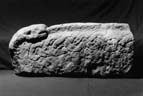
Object type: Incomplete hogback in two fragments [1]
Measurements:
a: L. 88. 9 cm (35 in) W. 24.8 > 15.2 cm (9.8 > 6 in) H. (crown) 37.4 cm (14.7 in); (beast) 38.1 cm (15 in)
b: L. 71.1 cm (28 in) W. 17.8 cm (7 in) H. 44.4 cm (17.5 in)
Stone type: As Easington 4 (All Saints), also with prominent bedding parallel to the broad faces
Plate numbers in printed volume: Ills. 226–33
Corpus volume reference: Vol 6 p. 105-106
(There may be more views or larger images available for this item. Click on the thumbnail image to view.)
Two large fragments of a hogback, from either end of the monument.
Fragment a
The ridge has lost any decoration. The end-beast resembles a snake though it has laid-back ears, which are scooped and swept round. The jowl has a mouth-slit and two drilled nostrils. The flat, thin neck clings to the curved end of the stone, broadening towards the base.
A (long) : A falsely terminated run of three-cord plait in plain strand.
C (long) : Irregular interlace may have been a ribbon beast with double outline and segmented body.
Fragment b
The centre of the stone has been dressed back and squared off for ashlar. A stump of the ridge protrudes from the end-beast's jowl. The end-beast is identical with that on fragment a.
A (long) : A run of three-cord plait.
C (long) : The remains of irregular interlace terminate in an unpinned loop.
This is a type e hogback, the dragonesque end-beast being an east coast variety, notably at Lythe (p. 163, Ills. 553–6, 558–64) and Barmston further south (Lang 1991, 125, ills. 423–6). It is probably a debased form of the more naturalistic quadruped types found in Allertonshire, and its cutting is as primitive as the organisation of its ornament is incoherent.
