Select a site alphabetically from the choices shown in the box below. Alternatively, browse sculptural examples using the Forward/Back buttons.
Chapters for this volume, along with copies of original in-text images, are available here.


Object type: Shaft fragment [1] [2]
Measurements: H. 32 cm (12.6 in) W. 25.2 cm (9.9 in) D. Built in
Stone type: Coarse gritstone, sub-angular grains including feldspar and some mica. Very pale brown (10YR 7/4). The near source for this Namurian Millstone Grit (Upper Carboniferous) is the 10 Fathom Grit, found on the Barningham Moor watershed area to the south west.
Plate numbers in printed volume: Ill. 259
Corpus volume reference: Vol 6 p. 110-111
(There may be more views or larger images available for this item. Click on the thumbnail image to view.)
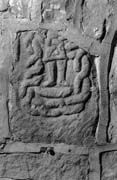
On the left is a narrow modelled edge moulding. The lower portion of the face is plain. In the centre is the lower half of a human figure in a kirtle, his feet turned out. He may be bound across the waist with interlace strands. On the skirt of the kirtle is an incised triangle. The figure is surrounded on three sides by separate elements of stopped-plait twist.
This is rough, unplanned work whose quality is exemplified by the stopped-plait twist. The human figure cannot be identified since its upper half is lost, but if it were Christ then the binding across the waist could be compared with the bound Crucifixion, Kirkdale 1 (Lang 1991, 158–9, ill. 546) and the figure on Gainford 5 (Cramp 1984, 82–3, pl. 63, 297).
[1] The following are general references to the Forcett stones: (—) 1880–9, civ; Hodges 1894, 195; (—) 1896–1905c, cxxxii; Morris, J. 1904, 156, 420; (—) 1909–10, 72; Morris, J. 1931, 158, 417; (—) 1934–6b, 137; Pevsner 1966, 163; Morris, C. 1976a, 142; Bailey 1980, 191; Welfare et al. 1990, 18.
[2] The following is an unpublished manuscript reference to no. 3: BL Add. MS 37552 no. XIV, item 557 (Romilly Allen collection).
