Select a site alphabetically from the choices shown in the box below. Alternatively, browse sculptural examples using the Forward/Back buttons.
Chapters for this volume, along with copies of original in-text images, are available here.


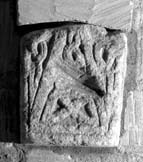
Object type: Part of cross-shaft
Measurements: H. 25.4 cm (10 in); W. 23 > 21.5 cm (9 > 8.5 in); D. 11.5 cm (4.5 in)
Stone type: Pale yellowish grey (10YR 8/2–3) oolite, with a calcite matrix containing closely-set ooliths around 0.4mm in diameter (range 0.3 to 0.5mm), some 1-mm pellets, and thin 1 to 2-mm shell fragments. Bath stone, Chalfield Oolite Formation, Great Oolite Group, Middle Jurassic
Plate numbers in printed volume: Pls. 397-9
Corpus volume reference: Vol 7 p. 202
(There may be more views or larger images available for this item. Click on the thumbnail image to view.)
A: The face is divided into a central triangular field by a wide plain moulding which encloses a single two-strand twist which develops into a four-strand terminal.
B: Part of a composition in which median-incised plain strands are interlaced with a pelleted strand which could be an animal body.
C: Broken off
D: Part of a broad stranded median-incised plait, of which one knot survives; a broader strand, in which a row of pellets is framed by narrow bands, seems to be part of a lacertine animal (see introduction p. 42).
The widely spaced strands and pointed terminals on face A are consonant with the cross-head fragments (Ills. 400, 401), and since the stone type is the same, this could be part of a cross of which Avebury 2 and 3 are also part. The lacertine animal or animal-headed interlace is also a feature of the cross-heads.
