Select a site alphabetically from the choices shown in the box below. Alternatively, browse sculptural examples using the Forward/Back buttons.
Chapters for this volume, along with copies of original in-text images, are available here.


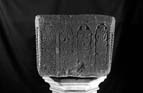
Object type: Font
Measurements: H. 51 > 48.5 cm (20 > 19.1 in); W. 68.5 > 65.5 cm (27 > 25.7 in); D. 62.5 > 60.5 cm (24.5 > 23.8 in)
Stone type: Sandstone, medium to coarse (very dirty). Lower Coal Measures Group, Carboniferous. [G.L.]
Plate numbers in printed volume: Ills. 814-7
Corpus volume reference: Vol 8 p. 277-8
(There may be more views or larger images available for this item. Click on the thumbnail image to view.)
A trapezoidal font, its arrises edged with a double cable moulding. The carving is in shallow relief. The arcading above some of the panels appears to continue around the arrises, except on the east face, where no arcading is present.
A (east): The upper part of the face, about one-seventh of its height, is completely plain, though there is a trace of a cable moulding along the upper edge at the right-hand side. Below, and filling its width, are four arched panels. The first two from the left are almost filled by extremely stiff, stylised bush-scrolls; at the top of each is a detached, mask-like face. The third has a plant trail with large three-leaved leaf-flowers. The fourth has what appears to be a different version of a bush-scroll terminating in a bunch of flowering stems at the top.
B (north): This face has a cable moulding along its upper edge. Below, it is divided into two broad panels above which is an intersecting arcade of three arches. The panels are completely plain.
C (west): There is no trace of cable moulding on the upper edge. The face is divided into two panels, each with a single arch above. The left-hand panel is plain, that on the right has a stiff central stem with three large, multi-petalled leaves on each side. The theme continues into the arch, where a leaf-flower on each side resembles those in the plant trail on face A.
D (south): On this face the intersecting arch continues down so that the two broad panels are turned into four, the outer two wider than the inner two. The panels are plain, but in the spandrel of the two outer arches there is a stiff plant form.
Appendix A item (Stones dating from Saxo-Norman overlap period or of uncertain date)
This should be compared to the font from Cawthorne, no. 5 (p. 275, Ills. 809–13). Ryder (1982, 112) thought it probably later than the Cawthorne font, but perhaps by the same hand. There are certainly similarities, especially in the disposition and form of the plant trail, but the first two bush-scrolls on face A, while certainly related to those at Cawthorne, are so much stiffer and cruder it is hard to see them as by the same sculptor, while that in the fourth panel is completely different. Collingwood (1929, 58) noted the Romanesque connections of the masks above the bush-scrolls, and another developed feature is the intersecting arcade. Though I believe they are probably by different hands, and there is probably some slight difference in date between them, they could be possibly from the same workshop. A most interesting feature is the continuing influence of pre-Conquest sculpture of the Dewsbury / Thornhill region.
